ئەرشیفەکانى هاوپۆل: English

Why are Anarchists and Libertarians divided over Rojava?

By Zaher Baher from Haringey Solidarity Group and Kurdistan Anarchists Forum.
14/07/2015

Like leftists and communists, anarchists and libertarians have been divided over Rojava. Some of them are very supportive and optimistic about the future of this experiment and the others are skeptical and suspicious.

There are many factors contributing to this. Some of these factors apply not just to anarchists, libertarians and others, but to the Kurdish people too. So this article may also be the answer to those Kurdish people who frequently ask why they do not receive support from political groups and ordinary people, not just about Rojava, but about any event in any part of Kurdistan.

The main factors are:

First: the attitude of individuals in Kurdish communities who live in Europe and other countries. Although many of us were born or have lived in these countries for a long time, we have not played a big role in introducing Kurdish issues including Rojava to the ordinary people in the countries where we reside, let alone to the anarchists and libertarians.

Of course, I am not talking about those Kurdish who are already members or supportive of the Kurdish political parties who do not like PKK and PYD, but about the supporters of Rojava. A large number of us (Kurdish) have been spread over all Europe and the US. If we want support for Rojava or any other part of Kurdistan, we need to get closer to the people in these countries and consider ourselves a part of this society.

It is a bitter fact that not many of us (Kurdish) think the country we live in is our country, its society our society. We do not think any changes in its politics, economy, education, housing, welfare rights, law & order and many more, directly affect us. We do not believe we are affected by immigration laws, though we are like many more black people and people from different ethnic minorities facing racism and discrimination from police and employers. Regardless of what happens, the majority of us are still silent and do nothing to get together with others to fight back.

While we share all the above issues with the vast majority of the people in any country we live in – and while some of these problems hit us harder – still we remain ignorant. We therefore do not participate in independent local groups, not going to demos, protests, not supporting the workers while they are on strike and on picket lines. We do not take a part in other campaigns to improve communities, whether the campaigns are local or national. So how can we expect non-Kurdish people to know us and support our causes including Rojava?

Second: The way we do our demos and protests. We do not know how to introduce our cause to passers-by or local people. The actual cause that we organize demos or protests for is usually lost among so many irrelevant placards, banners, Kurdish flags and pictures of leaders. We chant some useless and expired nationalist anthems. Because of this our demos and protests fail to deliver our purpose and just remain attractive to ourselves. While this is our way and our manner to introduce our causes to people, how can we expect them to know the exact situation, let’s say in Rojava?

Third: The historical bitter experiences that the anarchist/libertarian movements have had since the first International Workingmen’s Association in 19th century. They were involved heavily and supported by the Association, but were later kicked out and accused. This was followed in 20th century by bloody experiences with Bolsheviks, and then by the Spanish civil war in 1936/37. This history has repeated itself in different countries throughout the last century. Because of these terrible and bloody experiences many individual anarchists and anarchist groups remain very cautious in approaching Rojava.

In Rojava and Bakur (Northern Kurdistan-Turkey Kurdistan) we see a couple of powerful political parties, PKK and PYD, who have been heavily involved with both movements. This makes some anarchists struggle to understand or see the big steps that both movements are taking towards social revolution. They still look at PKK and its movement through the glasses of the end of the last century and beginning of this century. There is no doubt PKK did terrible things at that time: even Ocalan himself acknowledged that there was involvement in terrorist acts toward its own people and people outside of the party.

However, many anarchists do not see there is an internal struggle inside PKK over ideas and principles of anarchism: between the minority who tend towards anarchism and the majority who would prefer to keep the party’s structure as it has always been. I am sure the outcome of this struggle will be positive. It is not realistic to expect that PKK and PYD as a party will give up hierarchical organization. They cannot be transformed into an anarchist organization as a whole. However, a quick look at PKK’s history shows that it has changed and made many positive steps. For example, they do not believe in a nation state and the notion of United Kurdistan; to a certain extent they, or a proportion of them, are anti power, anti authority. They transferred their weight to the towns to keep the struggles among the workers and poor people; they are in the process of abandoning the guerrilla war and are involved in peace processes. They also believe in freedom: in people living together in peace and harmony regardless of their differences in ethnicity, religion, and gender. They are very serious about the environment and ecology issues and also believe in social revolution. They support forming radical local groups, believing in direct democracy and direct action. Not acknowledging the above comes either from arrogance or from simple ignorance and an inability to read the situation properly.

In my opinion the best attitude towards Rojava is “supportive and being critical” at the same time. Criticizing it alone and keeping distance from it does not benefit our current anarchist movement. This attitude again shows incapability of recognizing the reality of the movement, and would bring the blame of history over us. Meanwhile supporting it without criticizing its negative sides again shows that we do not see this movement realistically. Having this attitude, once the movement fails to meet our demands, we will be very disappointed and keep ourselves a far distance from any movement in the future.

Four: Ideological attitude and looking for purity and perfection in the movement. I believe this approach is at best naivety and at worst irresponsible. It is important to recognize this movement as a mass movement; how do we expect perfection in Rojava and Bakur unless we have perfect people? If we had pure, responsible and conscious people we would not need revolution. We need to look into Rojava with its all positive and negative elements. We should support the positive parts and we should be hard on its negative sides, not just to draw the attention of people to what is wrong, but also to support fixing it.

We have not seen a movement like Rojava since the Zapatista’s movement of 1994. What happened in Rojava with all its faults so far is the best we have, especially when we see the outcome of the Arab Spring, and that Rojava took exactly the opposite direction. Up to this point the movement has been stepping in the right direction although facing numerous attacks and threats: war with Isis and other terrorist organizations; the possibility that Assad’s forces will return and invade the region; the possibility of invasion by the Turkish government; the possibility of war with the Syrian Free Army; the reconciliation of neighbouring countries at Rojava’s expense; and the rebuilding of Kobane and the rest of Rojava by the US, Western Countries and their companies and financial institutions. Rojava faces all these threats and many more, so what is the attitude of anarchists and libertarians here? Solidarity and support to take the right direction or keeping distance and ignoring it until it loses whatever has been achieved so far? Which one is the right approach?

Five: Many anarchists and Libertarians come from Marxist or Marxist-Leninist backgrounds. Although these comrades have adopted some anarchist principles, some of their views, approaches and analyses remain Marxist. Therefore, they find it extremely difficult to believe the social revolution can happen in developing countries, especially somewhere like Rojava. This approach is ideological and borderline religious: they believe that if anything is not written in the old books it will not happen. Many of us know the Marxists’ books have confused people and distorted historical struggles about achieving socialism/anarchism. These comrades still use the same Marxist, Marxist-Leninist definition for the working class and the history of development in reaching socialism/anarchism. For this, they have posited five stages societies must go through before our aims are achieved. The five stages are the Primitive society, Slavery, Feudalism, Capitalism then Socialism; and, after these stages, Communism (they even separate socialism from communism). In somewhere like Rojava companies and factories are seldom found; therefore, in the view of the Marxist, there is no working class or proletariat. Rojava has not reached capitalism; how could the revolution start from there? How can dictatorship of the proletariat be set up while there is no proletariat? So any thought or any talk about starting a revolution in Rojava for these comrades is unacceptable.

It is a great pity our comrades cannot consider the exploitation of people throughout history has been the main issue. There have always been class divisions, a tiny minority of elites and the vast majority of people beneath them. So regardless of the many stages mentioned above, one question has always existed, one struggle raised; and this will remain the same until we achieve a classless society.

There has always been an alternative, there have always been grounds of replacing society as we have known it by forming and building a socialist/anarchist society. There is no doubt that societies have developed and progressed throughout history, but the social revolution has nothing to do with this division or to do with the condition that societies should reach capitalism before socialism. The need for revolution lies in exploitation, having people on the top of society with all the privileges and the rest on the bottom with nothing or very little. The basis of revolution lies in people’s consciousness, and their readiness to rise up. In other words, the social revolution can happen in any society, anywhere, regardless of the stage the society is in; but the total victory of any social revolution depends on many factors, whether this revolution happens in Rojava or in any advanced country like the UK or US.

History shows that human beings so far have only seen a couple of stages: societies which are Primitive, and the class society which continues until the present. There is no doubt that the division of human history to reach socialist/anarchist society damaged the social revolution badly. How the leftists and communists throughout the last century and earlier damaged the class struggles and principle of socialism as much as the right wing politicians and their parties is a separate subject. I will write about this soon.

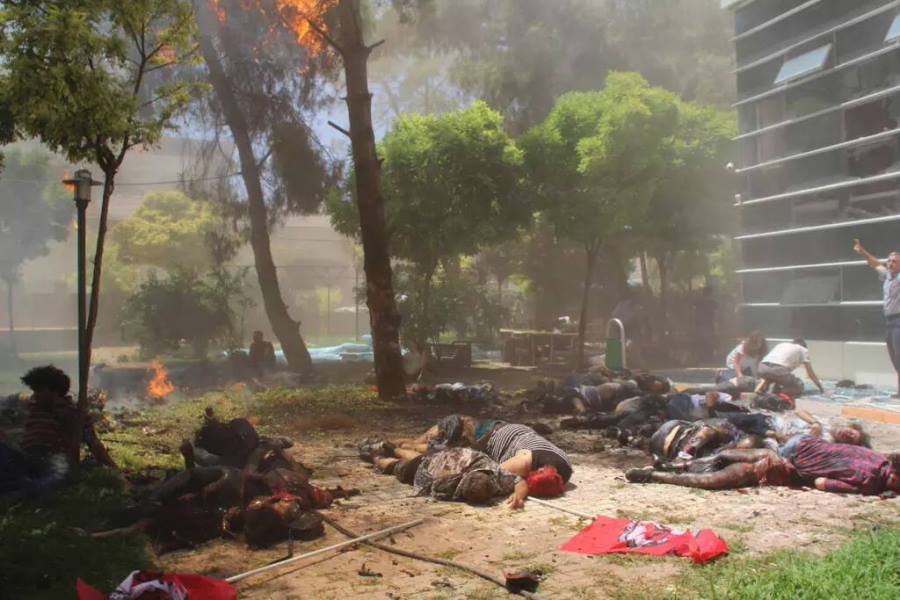
OUR SADNESS WILL BE OUR ANGER, KOBANÊ WILL RECONSTRUCTURE

OUR SADNESS WILL BE OUR ANGER, KOBANÊ WILL RECONSTRUCTURE

Yesterday, nearlaay three hundred people set off from different cities, with
the call of Federation of Socialist Youth Associations; in order to rebuilt
Kobanê, which was tried to be looted by the ISIS. Today, arriving Suruç
(Pîrsus), just before leaving for Kobane, these young people made a press
release in front of the Amara Culture Center in Suruç (Pîrsus). At the end
of the press release, a bomb exploding in the middle of the crowd, silenced
many hearts which had been beating with the hope of reconstruction.

According to the information for now, 31 people died and hundreds are
wounded in the explosion.

After this explosion today, we hear the names of the fallen ones, from the
hospitals of Suruç (Pîrsus). The ones who set off from many different
cities, the ones with great hopes in their hearts, are now the fallen ones,
on the target of the murderers. The people who are going out to the streets
in order to call them to account fort he fallen ones, who are waiting in
front of the hospitals; are threatened with TOMA and the police who arrived
Amara Cultural Center, sooner than the ambulance. In Mersin, in Sert, in
İstanbul… The people who go out to the streets are wanted to be massacred
by murderer state,by the collaborators of the murderers.

The ones who has massacred numerous lives, starting from the first day of
the Kobanê Resistance, are now trying to discourage us by murdering our
siblings.

We are trying to reconstruct a new life against the ISIS, against the state
collaborating with ISIS, against the war politics of the state which never
end. Whatever it costs, we are going to put on our sorrow, as our rage, we
are going to reconstruct Kobanê and recreate a life on this looted
geography!

(Today, two of our anarchist friends named Alper Sapan from Anarchy
Initiative Eskişehir and Evrim Deniz Erol from Urfa were murdered in the
attack.)

Bijî Berxwedana Kobanê! / Long Live Kobanê Resistance!
Bıjî Şoreşa Rojava! / Long Live Rovaja Revolution!

We should not let Kobane and the rest of Rojava to be defeated by the big corporations and the international financial institutions.

We should not let Kobane and the rest of Rojava to be defeated by the big corporations and the international financial institutions.


By Zaher Baher from Haringey Solidarity Group and Kurdistan Anarchists Forum

03/06/2015


First of all, I should mention a couple of issues in Kurdistan of Turkey (Bakur) that are strongly connected to the subject.  Between 08/05 and 22/05/15 I visited a number of big towns in Bakur, including: Amed (Diyarbakir), Van, Colemerge (Hakari) and Gavar.   Later I returned to Suruc and was hoping to cross the border to Kobane.

My main purpose for visiting there were three important points: first: understanding the similarity and differences between the Democratic Self Administration (DSA) in Bakur and Rojava.  Second: Reconstruction of Kobane, and third the type of economy that Rojava can have in the future. Although the friends in Peoples ‘ Democratic Party  (HDP) , other organisation and the Working  Committees  of Rojava  in Amed and Suruc tried hard to arrange  my trip to Kobane but it did not happen.

There are two important issues to talk about. These are:

First: The 07th June general election in Turkey:


Turkey is facing an important election. It is historical, not just for the Kurds but the rest of Turkey. If president Erdogan and his Justice and Development Party (AKP) win, they will be able implement their hidden Islamic Democratic agenda. The human rights will suffer, the police oppression will increase, the prisons will be full of activists, the rights of individuals, women, ethnic minorities, and other religious almost will be disappeared and also will be a big setback for the peace process. . On the other hand If Peoples’ Democratic Party (HDP) passes the 10 % election threshold then AKP could be stopped from implementing its inhuman agenda. The HDP manifesto is very radical; even if only 50% of it is implemented Turkey’s Constitution could be reformed unless the military Generals take over.

I met many people in Amed, Van, Colemerg and Gaver.  Everybody was busy with election campaign for HDP.  Everybody from candidates, the campaigners and the ordinary people who I asked believe that the election of this time is a major event and anxiously look forward to seeing the result of 07/06. Their reasons for that are the following which is very difficult not to agree with them:

  • This is the first time that the Kurdish people enter the election having a political party, HDP.  Previously individual Kurdish allowed taking a part in election as independent it is also the first time many non-Kurds are united with Kurds inside HDP and share its radical manifesto that reflecting and protecting the same interest of whole parties.
  • It is quite clear that the AKP is not interested in a serious peace process with the Kurdish people. Erdogan has not taken a big practical step towards this goal. In fact AKP has been forced to agree to the peace process. Erdogan and his party are calculating that HDP does not get through the 10% threshold and does not become a major force in the Parliament to push the peace process seriously. So that wining this election will be a major achievement almost for everybody in Turkey.
  • The HDP manifesto is strongly connected to the life of Kurdish and non-Kurdish people.  It is a political, economical, educational, cultural as well as social manifesto. It aims at the equality between men and women, at reducing poverty, unemployment, homelessness and the power of the corporations. It deals with recognising Rojava’s Cantons, the Cyprus issue, tackling discrimination, recognising the right of the individuals, different cultures and different religions.


  • To rebuild Kobane, humanitarian aid and materials have to enter through Syria or Turkey. So that reconstruction of Kobane whether thorough the big corporations or through the international solidarity, has to be through Turkey.At present Turkey only allows humanitarian aid and winning the election is extremely important for rebuilding Kobane.

Because of the above reasons there is no doubt that the Turkey election of 07th of June has got its own speciality that very much different from any other election in many countries.


Second: the DSA in Bakur and their differences with Rojava:  


There are many similarities of the DSA in Bakur and that of Rojava. What both experiments share are self-reliance and belief that things can be changed and done differently. Creating different radical local groups, committees, people assemblies and the House of People in the villages, on streets, neighborhoods and towns. In both experiments there are working voluntaries; making decisions collectively through the people assembly or the House of People. This resulted in bringing back decision making into the hands of communities. This also leads to decentralization and weakening the authority of the state.


In both experiments, the environment is a major issue and become an important part of people’s agenda.

Making revolution from the bottom of the society is a core belief in both experiments. There is no promotion for religions or for nation state.


Naturally, there are many differences between the two experiments. This is due to a different socio-political climate; which gave the both experiments their separate characters. These differences might find themselves in:

  • The DSAs in Rojava emerged through the current situation in Syria, withdrawing Assad’s forces and the will and the determination of people in Rojava to do what they wanted to do. The one in Bakur have been the outcome of the long historical struggles of people under the PKK’s influences.


  • The DSAs in Rojava have been settled and are the main administration that people trust and use. These are independent establishments and have no opponents except in Aljazeera; where there is still some regime administration exist. So the DSAs in Rojava are free and have open hands. On the other hand the DSAs in Bakur and in many towns and villages have not settled completely yet. In the main towns, like, Amed, Van and Colemerg; people are in confrontation with the regime establishments. For example, in the town of Amed; there are no contacts between Municipalities and the governor, the head of police and the military forces. The same situation or even worse can be found in the town of Van. While I was there, I was told by people I had a meeting with that they turned into problems with the official authorities; when they wanted to change the names of their streets to Kurdish names.


  • The DSAs in Rojava have been recognized to great extend in the world. They have received a good attention, solidarity and support from leftist, communists, trade unionists, socialists, anarchists and     In contrast the DSAs in Bakur have been recognized as a work of PKK and PKK, which for the US, Turkey and the Western countries is a terrorist organisation.  Their poisoning propaganda has even affected the value and importance of the DSAs there.


  • The continuation of ISIS war in Rojave is costing many lives, the stability of the region. This war also affects very badly the financial position of this area. The situation is paralyzing most of the economics, politics and social future planning. Furthermore, there is a continues threats from other terror forces, like Syrian free army and the Assad’s forces as well. Whereas, in Bakur and until now, there has not been any war.
  • Rojava is an agricultural region and it is very rich in oil, gas and phosphates. Equally, Bakur is a very fertile land and ample source of water. The river Tigris is going through this region along with some other rivers. In addition the Van Lake is in the heart of Kurdistan. The area with it’s high and snow covered mountains can be a tourist attraction too. With all these resources the area can be self-sufficient, without a need from the central government.


  • Capitalism has not been developed in Rojava yet. There are no big corporations, companies or factories. Therefore, the ugly face of capitalism cannot be seen here. In contrast in Bakur there is some form of undeveloped capitalism. This is   as a result of a deliberate racist policy from the regime, to exclude Kurdistan from major developments.


  • The trade unions in Bakur are very strong and play a big role in Municipalities, the radical groups, people assembly, House of People and also in the work places as well. They have good relations with the three main Turkey trade unions. Obviously emerging the unions there relate to the industrialization of Bakur although not as advance as in the rest of Turkey.   On the other hand the number of the trade unionists and unions in Rojava are very small; therefore, they have a very little role to play.


In one of my meeting with people in Van they talked in details about the situation there. They talked about the heavy present of police and military forces in their area. These forces put a lot of pressure on people; harassing, humiliating and the threat of arrest. Despite of all these, the activists there continue to further their course to progress there DSA. They work in variety of groups; such as political, language, health services, women, environment and agriculture. It is estimated that DSAs can manage to 80% of Van. In 1056 villages there are people assemblies and in 40% of the area there has been some form of self managements. What is worth mentioning here is women’s 50% participations in these self management organizations.


In addition of the agricultural nature of Van; the region has a great potential to become a great tourist attraction. The House of people in Van has future plans to make it more attractive for tourists and have Eco-tourist projects to protect people and the environment.

One of the other problems facing people is the poor production up to 50% less than expected. This is due to the distraction activities of the regime’s forces. There is also the culture of lack of confidence among people and unwillingness of sharing, lack of freedom and political problems.


However, I was told by people there; that they face a mammoth task. It is not easy to overturn 500 years influence of the Turkish authority. Throughout of these years people have been marginalised, isolated and treated with utter disrespect. To change all these require a lot of work on the ground and on the individual level as well. But what is promising is the zeal and determination of the activists in the area.


In my meeting with co-president of HDP, another party chief and co-leader of Colemerg Municipalities, it became apparent that DSAs in the region are facing major problems. The situation gets worse more you get closer to the boarder. In fact there are areas are restricted by the military and people are not allowed to enter.

Despite all this; the Municipalities in Colemerg are determined to implement their main Ecology plan. They have agreed that Colemerg to be the Ecology Pilot. It has also been decided to work on this project as soon as the election is over.


Kobane and its Reconstruction:


After defeating Isis and Turkey’s regime in the war, Kobane could manage to pass the first test successfully. The USA and its allies took part in the war because they realised that either Kobane cannot be defeated or if it goes down it will take everything else with it. The first possibility would deprive the big corporations from rebuilding Kobane.  The second would add another black spot to the history of so-called “international community”.


The war and the sanction indeed made life in Kobane and the rest of Rojave miserable for  a long time but in my opinion both factors played a major role in surviving the  whole of Rojava.

The war there introduced Rojava to the world and particularly the leftists, communists, socialists, trade unionist, anarchists and libertarians. . It brought love, support and solidarity to Rojava and its people. Hundreds of people from different countries   travelled there to be in the front line against Isis and a few of them lost their lives. Hundreds more went there as journalist and aid and community workers to show their support and solidarity.

Using sanction against Rojava by Turkey, the Kurdistan Regional Government (KRG) and the regional countries all also played a role in surviving Rojava.  It prevented corruption, entering money, capital and hindered exploitation by businessmen and landowners. The simple life of the region managed to go on. People had to rely on themselves, work voluntarily and collectively. The true natural relation between the people continued.


Now Kobane and the whole of Rojava enter the economic test which is difficult indeed.  Many countries can resist militarily occupation but cannot survive an economic one.  Launching an economic war by the big corporations and the international financial institutions can be devastating.

This may start with the reconstruction of Kobane.  Rebuilding it could bring death or the survival of Rojava as a whole by initiating its social revolution.

In my opinion rebuilding Kobane may take one of the following roots:

  • Either through the work of big corporations and financial institution, like IMF, WB and ECB. This will no doubt benefit the big corporation in particular and the capitalist system in general as happened, by imposing so many dramatic conditions, in Africa and South America.
  • Or through international support and solidarity of the leftists, communists, trade unionists, socialists, anarchists and libertarians. This of course is a slow process but it is the only way that Kabana can be rebuild solidly and avoiding the influence of the big corporations.
  • It could also be done by contracting out some of the projects to some companies to supply materials and expertise but the actual work to be done collectively by the people. This is provided a close watch and scrutiny of the DSAs and the Tev-Dem. Could be imposed.


There is currently a big discussion among the politicians, academics and economists about the rebuilding Kobane and the future economy of Rojava.  In fact a big conference was held in Amed in early May regarding rebuilding Kobane but so far no decision has been taken.  While I was in Bakur I spoke to many people in important position. They all rejected the big corporations and explained that this is their own official and firm view.

Making no decision in rebuilding kobane through the big corporations and the international financial institutions is excellent decision against the interests of   US and the Western countries and keeps their powers out. In the meantime it is our duty all to help and support whatever we can to participate in reconstruction of Kobane in order to protect this shiny experiment. We should not let the blood of thousands of people who scarified themselves to liberate Kobane and protecting the social revolution in Rojava to go in vain.

I need your solidarity

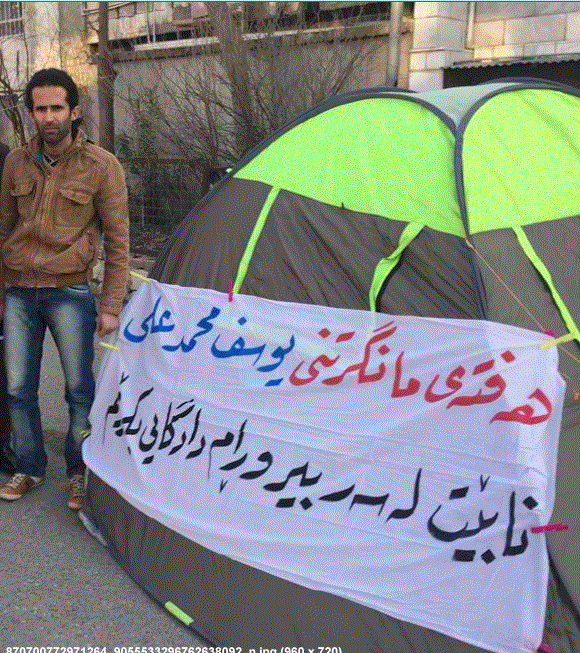
My name is (Yousif Mohaamed Ali), born in 1997. From my childhood beside my normal school studying, I started an Islamic study course with one of our religious neighbour until year 2002.

11094833_1564635100482841_1366733333_n

After my father’s death, I was in year 10 and I decided to leave my school and join full time Islamic Studying school (Hujra / Madrasa) until 2009.

After few months I realized that Islam nothing can provide to human and human being except destruction, killing, division, deterring, suppressing, and trouble making. For that, I left my religious study and came back to my father’s route, who was non-believer (atheist) and he never asked or punished me why I chose and practice Islam. When neighbour and family friends asked him about our different views on religion & Islam, he always replied with freedom in choice & thinking. At the same time I understood Islam never taught me about freedom of thinking except the principle of (with me or my enemy), which Islam and religion are based on.

In September 2009 I decided to go back to high school and continue on my study in my town (Darbandikhan). During this year in our school we had a scientific event and I participated with a lecture on (Big Bang theory). During my lecture few from my religious class mates were within audience. When they found from my views on nature that I am not anymore believe in religion, later they started with threatening and raised (Fatwa ) to kill me, but due to my reaction with reporting the group to local security and (whistle blowing) their secrets to local authority, they stopped chasing and hassling me.

During 2009/2010 I started to publish my comments, experience, and rejection of Islam in Face Book, some of my friends and followers were encouraged, supported and credited me, and some of my previous religious class mates started to attack me and categorised me as an (Infidel).

On night 3rd of December 2014 a member of the Islamic group, his name is (Halo Hakeem) threatened me with death, and he tried to implement my assassination plan during same night, because they know I will continue on my anti-religion activities.

To stop their plan, I called one of my friends who was working with local government security organisation in our town. I was advised by my friend to do not get out from my house when the terrorist knock my door, and keep in touch with him & local security if they approach my house. All these communications were happened between (1 to 4 am) at the same night.

For the following date I received another threatening message from same person, and I went to local police station, and reported to the police. During reporting my case, same terrorist attended to police station and he tried to attack me, but the police officers stopped him.

Day after we went to court, but the judge was a member of one of the Islamic groups, and he did not take the case seriously in purpose. At the same day at 6 PM they managed to find my non-published scientific articles under the title (Is science fit with Quran?), they printed and handed them in high court in (Darbadikhan). Later high court decided to prison me. Same day in two hours time, three police cars came and surrounded our house. They took me to the main prison and later to the court again, and the judge humiliated me by attacking me with his non-professional & non-legal words & phrases. The outcome of the court was 15 months prison.

Police took me to an individual cell for 6 days and they isolated me from my family and other contacts until they transferred me to main prison in (Sulaimani). We tried with Darbadikhan court to release me on bail, the judge did not agree and he extended my prison time from 15 to 22 months.

Responding to the courts outcomes, activist and intellectual campaigned under the name (No for ISIL rule/law in Kurdistan), they managed to collect 500 signatures for my release. Under public pressure they released me on bail after finishing 17 months of my prison time.

After my release in prison, the activist directed my case to (Kurdistan Human Right) to engage with high court in Darbanikhan to close the case, but the judge was insisted on his previous judgement and (KHR) was told that I am infidel and should be punished further.

Following this, we approached (Kurdistan Parliament) in Erbil, we handed the case, unfortunately they did not respond for 50 days. Later we approached (UN) in Kurdistan to protect me. They sent somebody, and interviewed me. After one month they replied and I was advised that they can not help me. After UN’s feedback, on 22nd of Feb 2015 I started with strike in front of (Sulaimani Parliament) for one week, also they did not do anything for me.

Now, depending on court’s schedule, I must attend the court on July 13th 2015. Depending on my layer’s information, the assigned judge for my case is religious person and affiliated with one of the Islamic Groups in Kurdistan. Depending on my layers experience & information per article 372 in our local law which mostly Islamic based law, I will face 2 years and 9 months prison.

Currently I am in a small village far from family and friends, waiting for worst outcome and fate. I hope you have few minutes time to read this message and put yourself in my position. I NEED your help please, before religious & their barbaric law can distroy me. I tried to see the head of (UN) in Kurdistan few times since, but they did not facilitate to see him, and they responded with different reasons/excuses.

Please help me and lend me because non of Kurdish parties are up to do anything for me.

With best regards

Yusuf Mohammad Ali 2-4-2105.

Kobane’s Second Phase: Resistance and Necessities

Kobane’s Second Phase: Resistance and Necessities

After 134 days of fierce resisting and defending. The women, men and their combatants with the support and solidarity from millions of people around the world had finally defeated the vicious attack from ISIS and liberated their town Kobane.

This was not just a defeat for ISIS and it’s dream to establish an Islamic Kelifat. But it had also destroyed the ISIS’s ally the current Turkish government’s dream to resurrect a Neu-othman empire.

The attack on Kobane was a proxy war launched by ISIS on behalf of the regional regimes and others against the bravery people in Kobane and the Democratic Self administration (DSA).

This war has left a great impact on people of Kobane socially and psychologically and including the people who left the town and sought refuge in the neighboring regions.

The war is not over yet. The ISIS is still intimidating and threatening the villages around Kobane with their frightening missions and propaganda. Obviously, this threat will remain until their total eradication from the region.

We are now in the second stage of resistance and that is to deal with the aftermath of the war. Clearing the land mines, unexploded bombs and explosives. Clearly, this operation cannot be achieved by the people of Kobane. This needs technical support and expertise.

To rebuild Kobane: the people of this town need the international solidarity from the vast majority of people in the world in order to save the Democratic Self Administration. This is the only way to protect the revolution there. Asking the international finance bodies and big corporations to help with the rebuilding of the town is not the best option. In fact this approach as the history tells us might well results in destroying the revolution altogether.

Some suggestions for the international solidarity and support in reconstruction of Rojava:

– Forming committees and associations to collect money, reconstruction materials and cleaning the environment especially in Kobane .

– Opening bank accounts for donation and making contribution under the control of the Rojava Solidarity groups in towns and countries.

– Forming different groups and committees in the towns of any countries where is possible to collect anything, any materials that Rojave needs for reconstruction. Ensuring that whatever has been collected will be transferring quickly and safely to Rojava. Setting up storages on the borders of Kurdistan region of Iraq, Iran and Turkey before transferring them to Rojava through opening of humanitarian corridor.

– Collecting medicine and hospital equipments to all three Cantons of Rojava: Jazeera, Kobane and Efrin

– Building schools, hospitals, play fields and special places for rehabilitation and psychological supports of war’s victims and refugees.

– Providing independent telephone lines and Internet connection to all three Cantons : Efrin, Jazerra and Kobane, not relying on neighbouring countries lines any more, the lines and Internet connection should be outside of their control.

– Allowing the volunteers who can help physically and mentally to go there in order to participate directly to support people and also helping in reconstruction of Kobane and the rest of Rojava.

– Allowing the volunteers who are expert in energy fields, agriculture, industries and building construction to participate and offer whatever they can.

– Any steps that will be done must be in consultation with the local people in Rojava who involved in Communes and the rest of the other local groups with coordination with people of DSA and they should be the decision makers.

– We see the participating and solidarity to Rojava as an anarchist natural practical duty. We hope the above suggestions and some more from other comrades be put in practice. We believe this practical work should not be just related to Rojava , but can be considered to anywhere in this world especially those places that has been destroyed by war. This can be an evident that anarchists work in rebuilding the society in every aspects of life.

We believe that nothing is perfect and immune from criticism, so do these suggestions. We hope our suggestion create debates and discussion among all the anarchist comrades . We also like to stress that our suggestions are not just about Kobane / Rojava because there is possibility that we face the same duty in elsewhere in this world in nearest future .

Kurdistan Anarchist Forum (KAF)

4th Feb 2015

The Experiments of Rojava and Northern Kurdistan (Turkey) for launching the social revolution left no doubt it has to start from building the local groups

The Experiments of Rojava and Northern Kurdistan (Turkey) for launching the social revolution left no doubt it has to start from building the local groups

Zaher Baher from Haringey Solidarity Group and Kurdistan Anarchist Forum.

Jan 2015

The history of movements and human struggles wanting to launch a social revolution, rather than just a political revolution are scarce, and social revolutions have happened in very few countries.  In spite of these facts those revolutions, or attempted revolutions, are still shining examples for us all. They remind us that either a revolution must be social or it does not exist as a revolution. In other words, it must be inclusive and must apply to all aspects of a human being’s life including their culture, education, economics, ecological & environment, health and care as well as the political.  This means we must have a social, as well as a political, revolution while at the same time taking the revolution out of the hands of the politicians, political parties and elites and putting it in the hands of ordinary people.  In a few words, starting it from the bottom of society and not the top, from the demands of ordinary people who have been for a long long time marginalised, deprived and exploited.  This is the only way we will achieve and maintain major changes.

In the last century the people’s history, in general, has been a very dark history, although in a few countries for a short time there has been some positives.  But, generally, it has been a history of slaughter, big and small wars, starvation, unemployment, poverty and displacement of millions of people.  Furthermore it has been the history of exploitation, child labor, and an increase in nationalism, racism, fanatical religion and much more. The main causes of this have been capitalism, free markets and globalization who have tricked us under the guises of prosperity, improving humanity, equality and social justice.

And the situation is the same whether a country has a so called democracy, dictatorship, coup d’état or Monarchy. These things have been very effective tools and instruments that remained in the hands of very rich people, aristocrats, the bankers, elites and the big corporations to serve and maintain the system for their benefit.

There is no doubt that politician and political parties have their own agenda and they use these agendas to climb to power. To gain this power they will not hesitate to do whatever they feel needs doing especially in the Middle East, Far East, central Asia, some of the African and Latin America’s countries, Russia, Spain and Portugal.

History has shown that all the political parties (from left to right, conservative to liberal, communist to authoritarian socialist, from religion to nationalist) have very similar economic and political interests and have very little differences between them.  In attempting to reach that final goal which is overall power, they are all happy to exploit and deceive the working class. At the same time although politics play a big part amongst the working class, poor and ordinary people they don’t see that they have a common interest. Therefore the working class is divided and don’t struggle together for their common interests. In other words they don’t manage to break the circle of their marginalization; they stay un-united and remain slaves to both bosses and land owners.

Through the present system all political parties aim to divide and separating working/ordinary people by creating feuds between them. This could be by wars, high levels of unemployment, starvation, homelessness, displacement to religious divides, racism or nationalism. All these negative attempts work well to maintain the present system and amazingly the people still trust the politicians and put them back in power.  Of course, there are other powers supporting them.  I call these powers the “Dark Forces” and mean things like, the media, banks, big corporations, churches and mosques. (I have written a long article in Kurdish on 14/11/12 about them and their roles in society).

There are now many people who have reached the conclusion that they have no trust or confident in any of the political parties but are also confused and have no confident in themselves and along with having their own personal difficulties, just sit back and do nothing to change things.  There are also people in society who believe that changing the government is the only political change we can make, rather than looking at changing the whole system. These changes are nothing more than small and non essential changes – its major changes like changing the whole system that we need. Wrongly many people seem to doubt that these major changes, and the social revolution, can be achieved through the local groups structure.

I do not want to talk about the local groups and their role here in detail as I have mentioned these in both my reports about Rojava and Northern Kurdistan- http://libcom.org/news/experiment-west-kurdistan-syrian-kurdistan-has-proved-people-can-make-changes-zaher-baher-2, http://www.anarkismo.net/article/27623- and also I wrote a very long article in Kurdish on 16/01/2012 under the title of “Why building the local groups are necessary?” I want to draw the reader’s attention to the experiment of Rojava and Northern Kurdistan and the influential role local groups played in launching the social revolution, and limited the role of the political parties. This was by forming and developing radical local groups, committees and communes.

Although the two examples below are similar in term of their aims, the structures of their local groups and having a couple of similar parties behind them, they have emerged in two different lands, with different political climates. Hopefully we can all see one, if not both, of these experiments as having a beneficial impact.

The first one is the experiment of Rojava. After the Syrian government’s army was forced to withdraw, The Movement of the Democracy Society (The Teve-Dem) emerged by building a variety of different local groups which then led to “The House of People”. Although this experiment is facing threats from a number of places it is still progressing, improving, developing and achieving more and more. Therefore, it has been very attractive to, and receives much needed support and solidarity from, many of the left, socialists, anarchists and libertarians from around the world.

The second experiment is that of Northern Kurdistan in Turkey. As I said above, Rojava is almost free of Assad’s forces and the people there regardless of their ethnicity, race, religion or nationality were free to do what they wanted.  There, people launched the social revolution from the bottom of society, which in some ways was not a difficult task. Obviously there are many obstacles and barriers as they face the threat of a return of Assad’s Regime, a terrorist war against them, civil war, and a potential war between the different Kurdish political parties. There are also economic and educational sanctions and other problems as well.  But, the experiment in northern Kurdistan is different.

In northern Kurdistan the Turkish government is still there and continues to use terror against political and community activists, trade unionists, and their families. After visiting there at the beginning of November 2014, I wrote a report (dated 14/11/2014) stating that the people there no longer  wanted to be suppressed/oppressed by the government; do not want to be humiliated; do not  want to be deprived of their natural rights; and do not want to be eliminated.  So while there is a fascist power there which tries to subdue the people to its wishes, there is also unbelievable resistance. A resistance which is using new tactics of struggles and developing new strategies in an attempt to defeat the government and force it to accept the people’s demands and wishes.  The people in Northern Kurdistan have become a major force who are managing to resist, defy and reject the system. It has become a new power outside the established power – a people’s power against the government’s power. This is the power of the people and this power, day by day, develops and going forward is getting stronger. This is a social movement that is the start of a revolution from the bottom of society, which will reduce the power of the state and eventually will replace it.

What’s happening in Northern Kurdistan is down to the essential and tireless work carried out by the local groups.  We can see its beauty, and the influence of these struggles weakens the power of the state and government.  These groups reduce the power of the elites and return decision making and responsibilities to the hands of local communities. We can all benefit from these struggles and experiences and the tactics used. The fact that local communities on both sides of the border achieved these remarkable social revolutions should be an inspiration to all communities throughout the world.

Using the knowledge and experiences from both experiments either of these examples can be applied to any country in the world. People can establish their own democratic power and administration in the absence of the central government as is the case in Rojava, or they can set up their own local community base even though a centralized power structure is in place, as has happened in northern Kurdistan.

I acknowledge that in both experiments political parties are still involved, be it the PKK or the PYD, and they still carry some influence over the people and the movements. There is also no doubt that inside these political parties there are those who support the social revolution.  Politicians in both parties know very well every crucial step in the development and progress of the Movement of the Democracy Society (Tev-Dem) reduces the influence of their power. We all know that whenever social movements are strong, the power of political parties is weaker and the opposite is also correct.

The social movements in both regions (Syrian Kurdistan and Turkish Kurdistan) neither now, nor in the future, will be tamed, controlled nor completely defeated easily.  At the moment a new culture has been adopted. A new experiment from being a toddler to walking and stepping forward is a fact. A new generation lives in harmony and freedom, accustomed to achieving victories. A women’s movement is also playing a major role throughout the local groups, different committees and communes.  These women are tough, educated, brave and very confident and a major force which is contributing to building a new society by changing themselves, but by changing society as whole as well.  In addition there is also the huge support and solidarity they are receiving from around the world.

So there is an existing culture, a new generation and a collective women’s rebellious voice that defies and fights back against the reactionary culture, political ideology and Stalinist discipline.  While these are in place they challenge the present political movement and fight the authoritarian power, like a non-people’s power, non-democratic administration.  While these are the grounds, the movement goes forward rather than backward.  This movement, even though political parties are trying to control or tame it, and even though there are unexpected internal & external events and intervening, all will be temporary and not permanent.

I do not hide my concerns. I am not totally optimistic about the future direction of Rojava. But I am extremely optimistic and confident about what I said in the a few lines above about the mood, feeling and courage of the people.  However, to achieve a complete victory a couple of essential bits supports are important.

First, there needs to be emerging the same or similar movements to The Movement of the Democracy Society in other areas of the region or at least in neighboring countries. Second the people of Rojava need solidarity, help and expertise with their economy, educational and financial systems. They need human forces, healthcare and all the daily necessities from socialist, anarchists and the libertarian around the world.

I believe there is still a strong resistance movement and a resentment of the system in both regions and neither will surrender the gains they have made. Furthermore people are now aware they are living under brutal systems with a vast majority of them deprived of their basic rights. I am hopeful that this raising of consciousness can be increased and this will push people to further stand up for their rights and fight back against the present system – to change it to a better world. A world of socialism / anarchism.

This consciousness raising is the keys to opening the gate which could take us to that society (Socialism/Anarchism) where we achieve all our demands.  I am very optimistic and hopeful that this can happen.

We are winning in Kobanê Today, and in All Kurdistan Tomorrow!

It’s been 130 days, the heart of Rojava Revolution was beating in Kobanê.

It’s been 130 days, people were resisting for life with their self-organization and will.

It’s been 130 days, women were growing the struggle for freedom.

It’s been 130 days, and it’s not only in Kobanê or Suruç; everyone and everywhere in this region wasrising up. The borders were being demolished and solidarity was uniting everyone.

It’s been 130 days, Kobanê was growing hope, not only against ISIS; but against the states of Asad, EU and Tc, and against the media that pumped despair saying “Kobanê is about to fall!”, against capitalism and the state.

It’s been 130 days, the resisting peoples were becoming free.

Kobanê was resisting for 130 days against borders that divided lives, against murderers that destroyed lives, the gangs created by states. The free lands of Kobanê was growing the resistance, blossoming hope, becoming a new life.

Today, after months of battles, countless lives lost in attacks of the state and gangs, the victory of resistance growing with the rage against the murderers is echoing all around the region. The victory of resistance is rising today from Miştenur Hill and Mekteba Reş and Memite and Kaniya Kurda.

Today, the gangs that the states created for their interests are running away though the ruins they are leaving behind in Kobanê. While the victory of resistance is echoing in the free streets of Kobanê, the conviction of freedom is rising above the same ruins in the streets. Like comrade Durutti says, “We are not in the least afraid of ruins”. Today and tomorrow, in Kobanê and many other places, we know that a new life is being created among the ruins.

Biji Serketina Kobane!

Long Live to Kobane Victory!

DAF- Devrimci Anarşist Faaliyet

Interview: Slovenia â uprising in Europe â what happened next?

Britain, The Anarchist Federation (AFED), Organise! #83 – Interview: Slovenia â uprising in Europe â what happened next?

Date Sat, 22 Nov 2014 11:37:39 +0200


GOTOVI SO! They are all finished! —- In November 2012 people in Slovenia (an ex-Yugoslavian country bordering Italy, Austria, Croatia and Hungary, EU member since 2004 and in Schengen area since 2007) rose up in a massive and widespread decentralised revolt that marked an intense and largely self-organised resistance to the economic crisis and cronyism. The uprisings started in the industrial city of Maribor against the corrupt mayor and city council, initially sparked by their introduction of a punitive traffic camera system which clocked up 5000 traffic tickets in its first 36 hours, with minimum fines a third of the average workerâs monthly salary for going even slightly above the speed limit. They were in reality born out of more than 20 years of transition politics from the break-up of Yugoslavia with capital accumulations and privatisations that had further increased inequality and powerlessness. Protestors readily torched the new cameras, which were such a visible and real act of municipal corruption during a time of austerity measures and privatisations, and then took to the streets.

The local anti-corruption protests, which had already grown in numbers to tens of thousands by early December 2012, quickly spread from Maribor to other cities, towns and villages throughout the country. During the uprising, state and municipal responses to the protests were harsh, with the use of riot police, and their attacks on demonstrations even included tear-gassing from the air by helicopter. The protests carried on until March 2013. Following the uprisings, the mayor of Maribor, Franc Kangler, the leader of the right-wing government, Janez JanÅa, and the leader of the opposition, Zoran JankoviÄ, were all officially accused by a Commission for the Prevention of Corruption.

A strong feature of the uprisings was the response of anarchists who included the Federation of Anarchist Organising, a sister organisation of the AF in the International of Anarchist Federations. AF members later participated in the 2013 Balkan Anarchist Bookfair, held in the Slovenian capital Ljubljana, and were most inspired by the activities of the anti-capitalist bloc that had been formed to bring together libertarian efforts during and following the uprisings. Organise! asked a member of FAO about developments since the uprisings.

When and how did the uprising end? Were there political concessions/changes?

This is hard to say. For sure, the window of opportunity closed after first three weeks. By this we mean the time when the impossible is possible, when the protests and riots were uncontrollable because they were simultaneously happening in many cities around the country and there were protests in small towns and villages that never saw them before. When the protests became more centralised they were more predictable, less dangerous for the system and therefore started to lose strength even though there were more and more people on the streets. For many it ended in the beginning of 2013 when the right-wing government fell. The anti-capitalist bloc that included many anarchists finished with the uprising in April 2013, after a protest during which an abandoned suburban community cinema was occupied for a few hours. Some structures like neighbourhood assemblies in Maribor have survived until today.

Did police/state repression continue after the end? Was there a support campaign?

Repression hits hardest at the end, when there are no more people on the streets. Hundreds of people were arrested, some already in jail sentenced, some still waiting for the trial. We try to keep in contact with everyone and there are several groups involved with the support campaign for them, demanding the release for all political prisoners and an immediate end of all legal processes around the uprising.

Can you name the organisations and groups involved in the uprising? Which organisations or groups still exist after the uprising? What are they doing now? Do they have continued discussion with FAO?

The uprising was egalitarian, decentralised and spontaneous in the sense there were no political parties or unions involved in it, and not even (mostly) any NGOs. People formed connections on the streets and new groups were emerging every day. Some are still active, others not. We tried to take the opportunity to make connections with as many as possible to find ways to co-operate to this day. The anti-capitalist bloc is one such structure that has survived and has still organises. Some who were not as progressive turned their energy into political party organising (like Syriza in Greece). That is unfortunate of course, but also
expected that people find it easier to trust their faith in the hands of (new) politicians, who will eventually disappoint them again, than in self-organising.

Do you think public attitudes have changed about anarchism since the uprising?

This is always hard to tell. What we know is that during the uprising people were ready to talk to us. Our tactics, ideas, strategies and methods, slogans, banners etc. were widely adopted. So this certainly contributed to the building of a culture of resistance. Whether we managed to transfer this collective experience into the next phase of struggle can only be told in time.

What is the situation like now with respect to political corruption? Has there been any social-democratic response?

New elections brought to power new parties and faces. The official left invented them in order for things to stay the way they are. Even if it was not planned – let’s not spread conspiracy theories! – they are a logical result of a ruling class that is fighting for their privileges. They are promising the rule of law but of course those laws are laws that keep the privileged, privileged and the poor, poor.

What is the economic situation like in Slovenia now?

More and more unemployment, more people in precarious jobs, bad atmosphere, no hope for future, the division among poor and rich is growing… Although the uprising didn’t change that it’s important we learned what we could have done better in order to be prepared for the future.

Have there been any other (smaller) actions from people since the end of the uprising?

Several, there have been strikes, protests, direct actions, debates… the atmosphere is bubbling and people are fighting at the level of everyday life to make their lives better.

What are the most positive things to come out of the uprising? Any negative things?

It was the biggest adventure of our lives (so far). Nevertheless, we don’t fetishise it. Events of such magnitude made us humble in the sense that we know now even better that even such great upheaval is only one dot in a long struggle against capitalism and all forms of domination. We try to change fear, depression and disappointment into strength, our mistakes into lessons for the future and our victories into courage to reach further. The best thing that came out were new connections, new lessons and experiences, the feeling the change is possible and the taste of a revolutionary moment that gives you strength to carry on.

Will there be discussion of the uprisings at the Balkan bookfair (Sept 2014 in Bosnia)?

Comrades from FAO joined forces with the US anarchist collective Crimethinc as part of their ongoing investigation and speaking tour âAfter the Crestâ. Comrades from Slovenia and US will therefore present a talk at the bookfair that addresses questions of lifecycle of movements aimed at sharing, among other things, experiences we got during our uprising in order for all of us to be better prepared when the next one comes along.

More information

Federacija za anarhistiÄno organiziranje/Federation of Anarchist Organising (FAO): http://www.a-federacija.org/english/ (the site includes articles and many excellent photos and videos of the uprisings)
Eighth Balkan Anarchist Bookfair, Mostar Bosnia, 5th-6th September 2014: http://bask2014.wordpress.com/
Crimethinc: http://www.crimethinc.com/blog/2013/09/09/after-the-crest-the-life-cycle-of-movements
_________________________________________
A – I N F O S N E W S S E R V I C E
By, For, and About Anarchists
Send news reports to A-infos-en mailing list
A-infos-en@ainfos.ca
Subscribe/Unsubscribe http://lists.ainfos.ca/mailman/listinfo/a-infos-en
Archive: http://ainfos.ca/en

nterview with a Ukrainian anarcho-communist “Anarchists have become the main obstacle to anarchy”

France, Alternative Libertaire AL #243 – Interview with a Ukrainian anarcho-communist “Anarchists have become the main obstacle to anarchy” (fr, pt) [machine translation]

Date Sat, 22 Nov 2014 11:34:16 +0200


Donetsk, a city in south-eastern Ukraine was the scene of clashes between pro-Russian separatists and Ukrainian population. A libertarian communist activist who lives there and campaigning gives us some tools to understand what forces and the reasons for the weakness of the libertarian movement. —- What is the situation in Ukraine? —- Life continues with two parallel realities: people continue their daily life, with children around, with the same place of the dead, violence, hatred. The division of society grows stronger every day. It is a political revolution of the national bourgeoisie in the context of civil war and ill-disguised Russian intervention. —- What is the social composition of the protesters Southeast and those of Maidan? —- Maidan and separatist South East does not greatly differ from one another. Both bring together a variety of social classes, intellectuals, employees, contractors, rural, students, lumpenproletariat, former military… All become hostages and puppets economic clans.

Maidan people have the power of new oligarchs, and the people of Southeast ensure the order of the family of deposed President Yanukovych and his master’s in Moscow. All this rhetoric is flavored with nationalism. With the result of bloody wounds and anger for decades. In fact, the enemy is the Kremlin, the Capitol and the Bundestag. Leaders Maidan as the separatist leaders are fractions of the national bourgeoisie and its radical elements.

In the East, they scare people with Pravyi Sektr (“Sector Law”) and the call to fight fascism, as they are inspired by the imperial fascism of the Russian nation. In Donetsk, according to their logic, you have the choice between being Russian or be a fascist. For a Ukrainian word, you are beaten or killed. It happened at Maidan and it happens now in the Southeast.

What about the referendum of May 11 [1]?

This is a referendum marked by its polling without observers and under the watchful eye of masked person. It was a farce is part of a strategy aimed at creating popular independent republics, and then apply for admission in the Russian Federation. But there is a lot of people from Donetsk and its region who favor a united Ukraine. The separatists are better organized, have better administrative resources and support from the neighboring state, that’s all.

Do you think that there are Russian experts in the Southeast?

I do not think, I can confirm. And many of them are in training bases in the Donetsk and Lugansk, where groups of 400 to 500 local volunteers and Russia are coached by military instructors direction. (…) The majority of people who are fighting under the flag of the separatists are local, ordinary workers or military veterans. But a significant number and authoritative is trained volunteers who organize the Russian process. Supplies, weapons and money from Russia. The current head of government of the self-proclaimed “People’s Republic” in Donetsk Boroday strategist appointed by the Kremlin administration.

Will it a possibility that the protests turn into a social revolution?

For now, this is an unlikely scenario. A social revolution is possible only in the presence of two factors: a massive demand for radical change and the political organization of the revolutionary wing anarchists, who will be able to defend the change process.

In reality, there is no demand for a social revolution. The only change is conceived within a political framework. And even those timid shoots anti-autoritaritarisme that may have arisen, as they are not supported by a strong anti-authoritarian revolutionary organization will be destroyed by the political agenda of the bourgeois and nationalist parties.

What are the prospects for anarchists in the current context?

The main problem of the anarchist movement is the lack of an anarchist organization. The anarchists were unable to use the situation because they were captives of anti-organizational illusions.

The organization is an incubator, a school, a mutual aid society and a productive platform for ideas and projects; but most importantly, it is a tool for the realization of ideas, it is an instrument of influence and control instrument. It can not be replaced by peer groups.

Anarchists today as in 1917, missed the opportunity to be influential in the process. The RKAS [2] claiming anarchist Makhno reformist platform has survived many crises, was involved in the miners’ strike, and had several long-term projects, but were not without quarrels and divisions internal.

We can remember the anti-electioneering splitting the RKAS the Mezhdunarodnyj Souz Anarkhistov [3] in Donetsk. The separatists argued the alleged authoritarianism RKAS. Once freed from the “dictatorship of organizational office RKAS” which was to go into the mines and factories, the newspaper spread anarchy, and discuss with the unions and cooperatives, and was building a “black guard” self-disciplined, they showed their strategic and ideological capacity pasting posters made by hand, with the message “Do not go to elections, eat vegetables. “

All attempts to build the organization through the RKAS project resulted in a crusade against “authoritarianism and extremism.” Finally, anarchists have become the main obstacle to anarchy. I used this paradox to bring your attention to this old disease “anti-corporate” destructive and irresponsible (…). Perhaps the RKAS reborn taking into account all the errors and modernizing; we can create something new. (…) We will not give up and we do not disappear.

In what are you involved in now?

Unfortunately, I can not tell you everything. Otherwise, a lot of good people and I have multiple problems, and we have a lot of project in the future. RKAS officially was dissolved, but its core has shifted in illegal actions.

This is a summary, reshaped by Jacques Dubart, interview an activist RKAS – Revolutionary Confederation of anarchist-syndicalists – available on anarkismo.net translated text published in English on August 9

[1] 1. As a reminder, it is the self determination referendum in Donetsk which has “asked” for unification with Russia.

[2] International Confederation anarchist association.

[3] International Union of Anarchists.
_________________________________________
A – I N F O S N E W S S E R V I C E
By, For, and About Anarchists
Send news reports to A-infos-en mailing list
A-infos-en@ainfos.ca
Subscribe/Unsubscribe http://lists.ainfos.ca/mailman/listinfo/a-infos-en
Archive: http://ainfos.ca/en

The social revolution will sweep Turkey Kurdistan sooner or later

The social revolution will sweep Turkey Kurdistan sooner or later


By Zaher Baher from Haringey Solidarity Group and Kurdistan Anarchists Forum

Below is the outcome of my visit to Northern Kurdistan in Turkey between 02/11/14 to 08/11/14 as one of a delegation from United Kingdom, organised by Peace in Kurdistan Campaign (PIK), People’s Democratic Party (HDP) and Democratic Society Congress (DTK).

Throughout the visit we had a chance to meet many organisations, including political parties, local and regional Trade Unions, co-Mayor of Diyarbakir and Suruc, the Coordination of humanitarian aid to the refugees, Refugees Camps, Villages at the border of Kobane, representatives of Democratic Free Movement of Women, Human Rights Association, representatives of democratic Region’s Party, the Bar Association of Diyarbakir and finally meeting with the Federation of the Families of Detainees.

During our meeting with the people we had total freedom to ask the relevant questions about the situation, their responsibilities, their approach to the problems they are facing, and their current and future tasks.

There is no doubt that each of the above organisations was overloaded with work, shortage of funds, humanitarian aid and lack of support from the central government. These were because of the following  reasons:

a – The war in Kobane had created a big problem in the region due to the overwhelming number of refugees form the city and by the Eyazidis from Shangal (Sinjar Province). This has created a big problem for each of the above departments.

b – The slow pace of the peace process between PKK and the Turkish government, which is nearly halted. This obviously made the people angry, frustrated and disappointed.

c – Continuing the war in Kobane has caused more killing and displacement of people, while there is no clear sign of defeating the Isis. There is evidence that the Turkish government is supporting Isis.  These are reasons for more demonstration and protest and vicious response from the police that destabilises the situation further.

The most important observation in our visit is the fragmentation of organisations, and the formation of a variety of bodies in different places.  A few of these were old but many had developed during the last couple of years. Each of them is working for progress of the society towards stability situation, peace, freedom, social justice, human rights, There was some signs of coordination among them.

Many of these bodies have been formed as a default and forced themselves over the situation and the central government.  This is a reason for seeing some tension between them and the government. It is amazing to notice that while the Municipality of Diyarbakir is elected by the Kurdish people but has no contact with either the head of the police or the governor of Diyarbakir. This is the case with other departments. For instance, when we asked the Human Right Association whether they have written to the police about their behaviour and harassment of local people, they replied saying that “There is no point to write to them as they never answer us.” There are many Kurdish schools but the state does not recognise them. The people however strongly support these and are confident that one day they can force the state to recognise them. It is interesting the people are defying and challenging the power and the state. There is a power within the power. There is ‘’people’s power’’ that people believe in, work with, have forced themselves through the actual state’s power and have made it workable and powerful.  This is the way for them to gradually take back the power form the elite minority. While this is not difficult in the cities that overwhelming majority are Kurdish and believe in changes. This is how the social revolution starts from the bottom of the society, and not from the top.

After 28 years of war, PKK has realised that they must change their direction of their struggles, their aims and their strategy otherwise their future won’t be better than the future of other movements,

In my opinion PKK or at least the dominant faction or group within the PKK, has taken the right decision and the right direction by silencing their weapons and opening their minds, changing from military forces to people’s power and from political revolution to social revolution. The wave of the social revolution is so strong it will be extremely hard for anybody or any political party to change its direction let alone to stop it.  It became a culture, custom especially for the young generation, they have realised that is the only way to defy the power, to challenge the system and make major changes.

Through talking to people, they are so confident that they can make changes.  In meeting Democratic Free Movement of Women, there were 9 women present.  They told us how they deal with women’s problem in the society, like domestic violence, rape and other abuses, how to support individuals in every ways to make them confident to tackle their problem. A few of them were talking about their own experience and told us since they joined the movement, in fact they have nearly became another person. They take part in women’s peace camp, sharing mission, they discuss the books they read and working with Kobane democratic federation women. When we asked them whether there was a gay or lesbian groups in Diyarbakir? In reply they said “ there are a couple of groups  in the town, we  have contacts with them and we  are very supportive to them.”  It is amazing to see in a town like Diyarbakir there are women’s movement with very brave and open minded individuals and are very supportive.

The Federation of the Families of Detainees (Tuhad-FED) is another group we had a couple of hours to meet with.  This group was formed in 1996 under the nose of the government. It has 14 volunteers, half of them are women working tirelessly. Most of the foundation members of the group had very bitter experience of being in prison, as they were tortured or detained for a period of time. Its co-president of the federation is still held in prison. This federation is very active and has regular contact with the families and parents of the detainees.  They support them by keeping in touch, finding a lawyer for the detainees and fund the families of the poor to visit their beloved ones in prison.

This group is in contact with the different groups abroad and locally with the Human Rights Association (IHD).  In our meeting with the IHD, they confirmed that the police have arrested many people in the demonstration of 06/10 and 07/10/2014 against the Turkish authority. This was when many thousands fled from Kobane to Turkey against the wishes of the government. The demonstrations were against the silent policy of the state of Turkey supporting Isis. The head of IHD confirmed that just 5 minutes before our arrival, a couple of people came to their office to inform them that their sons, aged 16 and 17 years, have been taken away by the police. They were informed that during the demonstration 42 people and 2 police officers were killed, some 1128 people were arrested including 53 children, with 221 still in prison.

In a meeting with co-president of one of the Unions who works in a hospital, she confirmed the arrival of 128 injured and some very sick people at their hospital. The police have raided the Union office and the hospital a few times to find out whether anybody who helped the people at Kobane has been treated in the hospital.  When they found the presence of sick and injured people from Kobane they harassed her and other nurses, abusing them verbally and taking their identity documents from them.

In our meeting with the Bar Association of Diyarbakir, we met 5 Lawyers.  They told us that they have about 1000 lawyers in Kurdistan region working in different departments, caring for the rights of women and children or working at legal aid centres funded by the state.  They confirmed that no major changes have taken place since the start of the peace process. They were optimistic and felt that the situation will improve by next year when the constitution changes. They pointed out that there was a bail system but this did not apply to people who were involved in politics and their case had to be settled in court. When we asked them about making complaints about the police behaviour, they replied “We do not think it is worth complaining because the police do not listen and they will not change their attitudes.”

They confirmed that 2000 students were arrested and all over turkey some 3000 to 4000 people are still in prison This is in spite of the constitution which states that people should not be arrested for political activates or opinions. However, if one belongs to a certain political party or found carrying some sort of a banner or placard with slogans inciting hatred, he becomes liable to be arrested.

The plights of the Refugees continue:


Since the capture of Mosul, in Iraq, by Isis and the genocide of the Eyzidis and the start of war in Kobane, the Kurdistan region in Turkey is overwhelmed with refugees from both Kobane and Sinjar. More than 100,000 Eyazedis have fled, with many of them ending in Iraqi Kurdistan and some 18000 arriving in Turkey.There are also about 4000 of them staying in one of the camps just at the outskirt of Diyarbakir. The co- Mayor of Diyarbakir confirmed that there has been no support from UN. People in the region donated money towards the tents, food and clothes.  He said ’’ 90% of the donation and help came to Diyarbakir Municipalities from the local people and only 10% from the state.’’  He told us they work very hard to provide basic necessities of life such as tents, food, clothes, hot water, electricity, shower facilities, health clink and schools to their children. He mentioned that they have great difficulties as all the services have to be done by volunteers; they do not have enough people. They also lacked skilled labour, doctors, nurses, beds, ambulances and medicine. The Turkish government does not support them in providing the services and everything has been organised by the Municipalities.

We also met with the Union of the South East Anatolian Region in which Gabb is in charge of the coordination of humanitarian aid to the refugees.  This body consists of 286 members of which 30% are women. They elect 7 people to be part of the active committee. Half of their budget comes from all the Municipalities in the region and they have contacts abroad.  Gabb told us that they have an intensive plan for the next 3 months to coordination between refugee camps, between the refugees from Kobane and Shangal and also with Turkey to obtain information and humanitarian support. They also have to classify the people in the camp in term of their gender, age, health and other problems. They confirmed that they supervise and support 9 camps of refugee in which 4 of them Eyazidis from Shangal.  They confirmed that already around 6000 of them returned to Iraqi Kurdistan but received 96000 more who settled in Suruc, and 2840 in Mardin.

We also visited the refugee camp of Eyazidis where over 4000 people live. These people complained about quality of the food, hot water, doctors and nurses. They told us that due to lack of transport it takes 15 days to be referred to a hospital and moneyless refugees have to pay for their treatment.

In Surus, we visited the Kobane refugee camp which was set up on 15/09/14.  They have the same facilities as the Shangal refugees. It looked they lived in reasonable condition. We were told that they have 15 doctors, 20 nurses and many more on call to look after them. It seems they are happier  than the Shangal  refugees, probably because of the following factors:

a – They are very close to Kobane, where they come from, as this psychologically influence them, compared to the Eyazidis from far away Shangal.

b – The Kobane refugees feel their stay is temporary and will returned home soon. Shanglys have little hope of returning while Isis are in control of their region.

C – The Kobane refugees had time to leave home and some managed to take their valuables with them. The Eyazidis, on the other hand were faced with immediate slaughter. They have left everything behind and many of their relatives were killed. hundreds of their women kidnapped by Isis and sold into sexual slavery following the raids is still unknown.

d – The refugees from Kobane left while there were still people behind fighting the Isis forces. The Eyazidis people are bitter towards Massoud Barzani’s forces (The peshmarga), They informed us that as soon as the Isis arrived the Peshamrga withdrew and let the Eyazidis face slaughter. The withdrawal of the Peshamarga is a mystery and nobody knows whether it was on the order of Massoud Barzani, an agreement among Isis, the Turkish government and Barzani or something else.  When we talked to people in the Eyazidis camp some of them did not hide their anger and frustration against Masoud Barzani’s Peshmarga.

Turkish government has changed its tactic but not its strategy against Kurdish people:


Everywhere there people had one thing in common: ‘There has been no major change since the ceasefire of Dec 2012.’ The suppression and the oppression are going on, still the Kurdish community is marginalised, still you can see a major difference between Kurdish and Turkish towns.

There is not much support from the governor of the cities or from the central government to Municipalities that are controlled by the Kurdish people. The Kurdish community suffers greatly from joblessness and from health problems. People still live in big fear either for their own safety or their children’s being harassed, kidnapped or detained without reason.

It is true that the Kurdish people  are now in control of their Municipalities, and setting up many organisations, association, Unions and a variety of groups. However, they receive very little or no help from the government. It is noticed that the Kurds have forced their case and the Turkish government has no choice but to accept it. This may be due to the government hoping to become an EU member. Also the Kurdish have simply rejected the old situation. They are prepared to fight back and do not want to stop their social revolution which is at its beginning.

Things can be happened but should not be happened to derail the social revolution:

The situation is very tense and delicate. The peace process seems to have come to standstill. Kobane is still being seized, Isis is still a big threat to the region and it seems removing Assad from power is not possible for the time being. The US and the rest of the western countries can run out of a clear policy or strategy to defeat Isis and the Turkish government is not serious in the negotiation with PKK. These factors have direct or indirect impact on the situation in Turkey.

However, factors more important than the above which may derail the social revolution are:

a – Ending the ceasefire by PKK and returning to guerrilla war. This will be a disaster for Turkish society and the Kurdish community.  No doubt this may bring more killing, more destruction, more displacement of people, creating the feeling of hatter between Kurds and Turks, increasing the wave of racism and will have a negative impact on the region as whole and the Kurdish region in Iraq, Iran and Syria in particular.

b – The attitude of US and the western countries treating the PKK as a terrorist organisation does not help the situation. Continuing such a policy will bring no benefits either to Kurdish people or to their allies in the region.  These countries need to change their attitudes about PKK, they should understand that it is not the same organisation as it was in the 1990s.  They should consider PKK as a main force in the region and is very popular. It has indeed changed and progressed considerably during the recent years. Therefore the PKK cannot be marginalised.  The US and the western countries should force the Turkish government not to take the ceasefire for granted, they should all grab this opportunity to end this very long dispute.

c – The Turkish government has doubtful relations with Isis and the other terrorist organisations in the region.  For instance it uses them in a proxy war which may become extremely harmful to Turkey. The president of Turkey, Mr Tayyip Erdogan, and its government should leave behind their dream of establishing the old Ottoman Empire in the Twenty first century. Instead they should concentrate on its internal problems, especially the Kurdish issue.

d- There is still a big struggle between the military Generals and politicians in Turkey over power.  The peace process has never been in the interest of the military Generals.  Although currently  the struggle is getting less effective, the intervention from spy networks within the region along with the US and the western countries could revive this struggle and strengthen the Generals to do a military kudeta .  This obviously is not in the interest of the peace process and the social revolution by bringing back the old polices of suppression, oppression and killing innocent people and to return to the first square.