ئەرشیفەکانى هاوپۆل: English

Power, State, and Class: the two Fronts of Anarchist Struggle

Zaher Baher

Jun 2026

We Kurdish-speaking anarchists often come into contact with Marxists. They accuse anarchists of identifying the state as the main problem of this system while ignoring economic issues and class struggle.

What we face today is not new. Anarchists have always been accused of this by many Marxists. Of course, this is not the only accusation. They have also been accused of rejecting organization, promoting chaos and violence, and many other things, none of which are true and all of which remain unsubstantiated.

To enter into this discussion, we need to examine the principles of anarchism and Marxism in this regard. Then, through the answers to questions and arguments, the entire foundation of both ideas can be revealed, allowing readers to judge for themselves and perhaps raise many questions as well.

Marxists believe that the existence of the state is rooted in the existence of classes, which leads them to the view that the state cannot be abolished before class society is abolished. However, the principles of anarchism do not focus solely on opposition to power, the state, centralism, and hierarchical organization. They also emphasize economic issues, class struggle, freedom, equality, and social justice.

In my opinion, this issue must be discussed very carefully and supported with evidence so that anarchism, its principles, and the anarchist movement are not misrepresented.

Obviously, Marxists generally insist on political power being held by the working class, and for them the existence of a workers’ state, or the “dictatorship of the proletariat,” is a necessary temporary or transitional stage. They view the existence of the state as a means of moving from socialism to communism. In other words, the collapse of capitalism and the abolition of class differences occur through this stage, during which the state gradually disappears and society enters the stage of communism.

The anarchists’ insistence on opposing the state and authority is an undeniable fact. This is why Marxists find grounds to accuse anarchists of being idealistic rather than realistic. They view all anarchist struggles solely within the framework of anti-authoritarianism and anti-statism, rather than recognizing class struggle and the other principles of anarchism for which the anarchist movement has fought throughout history.

An important point in the Marxist view of the class question is that, when they speak of this struggle, they are referring only to the struggle between workers and capitalists, or between labor and capital, and this is largely confined to the sphere of industrial workers. At the same time, they attribute the basis of all historical events to this conflict. They even regard the history of human struggle primarily as the history of class conflict, ignoring the issue of hierarchy, which is the cornerstone of class formation, as if the history of struggle began with the history of classes. For them, once the issue of class is removed, the issue of hierarchy mechanically and automatically disappears and is resolved.

Their view denies the fact that the history of conflict in societies has not always been between the oppressed and the oppressors. Rather, the history of conflicts and major wars has more often been between the oppressors themselves, between authorities and states. All wars were wars of power, not class wars. Internal social problems and class issues have been used as tools or strategies to obtain different forms of power, such as economic, political, and social power. In other words, the history of conflicts has not only been between labor and capital, but also between the oppressors themselves, including rulers, tribes, and states. These wars existed thousands of years before the rise of industrial society or before many sections of the working class even existed.

As I said earlier, Marxists had no evidence for their accusations against anarchists, neither then nor now. Most anarchist tendencies or traditions, such as anarcho-syndicalism, anarcho-socialism, and anarcho-communism, have not only spoken deeply about class struggle but have also participated very actively in class struggle. Moreover, anarchist thinkers such as Mikhail Bakunin, Errico Malatesta, Emma Goldman, and Alexander Berkman have themselves supported the labor movement to the best of their ability.

In response to Marxists’ idea of a state and a temporary state, anarchists have argued that what they call a revolutionary state will not disappear but will instead create a new ruling class. The validity of this argument was, in their view, demonstrated in practice in the Bolshevik state and in all communist and so-called socialist states, as well as in the emergence of a new class of state officials and in issues of centralism and the weakening of the labor movement. History, they argue, has shown that centralized socialist states become authoritarian bureaucratic powers rather than creators of a society in which workers are free.

Anarchists believe that hierarchy itself is dangerous and reproduces the power of a dominant centralized state. Liberation, they argue, must take place through horizontal mass organizations, revolutionary federations, revolutionary syndicalism, and directly democratic communes, rather than through a “provisional revolutionary state.”

There are two important points here:

First, anarchists maintain that there can be no genuine freedom for individuals, communities, or societies, nor economic equality or social justice at any stage of society, as long as power exists in any form or content. History has provided hundreds of examples of this. Therefore, the existence of power is the foundation on which all lack of freedom, economic inequality, social injustice, and oppression rest. In such a situation, these conditions will not collapse unless the main pillar itself collapses.

Second, all changes that can and must be made, such as social, popular, and fundamental changes, must be radical. This is clear to anarchists, and they know how to address it. Marxists, on the other hand, aim to solve the above-mentioned issues through states such as the dictatorship of the proletariat or a workers’ state. According to them, if the workers have their own state and control the power and laws of that state, then all problems will become easier to solve.

History has shown that since the establishment of power, and as it later consolidates itself in the form of the state, there has never been a power or government that has not intensified problems instead of solving them. Under such a state, there have always been people who are deprived of their rights, even if they are a minority.

Therefore, the program and plans of Marxists, as well as the principles of Marxism, not only cannot eliminate the issue of class conflict but also lead the power they take over toward violence and dictatorship, instead of leading it to its disappearance and achieving the final destination of communism.

A couple of questions arise here about the economic mode and the mode of power: Which is at the root of the class problem? Will the seizure of power come first and eliminate the economic problem and class struggle, or will it be through the elimination of power and the state that the class struggle is resolved?

In my opinion, these two questions complete each other. Economic inequality does not exist without class problems. Similarly, economic inequality is based on power. It is inequality that creates power, and it is power that creates, maintains, and perpetuates inequality. We can see this very clearly in a pyramid diagram. In this picture, we can say that the basis of power is at the bottom of the pyramid, and the economy and economic issues, with all their problems, are at the top of the pyramid. No matter how much the top of the pyramid is broken, as long as the foundations, walls, and pillars of the pyramid have not failed, the same structure can be rebuilt, perhaps in different ways and different forms. It is obvious the class issue and the economic problem are still there, and what has changed is the type of power, such as dictatorship, democracy, liberalism, neoliberalism, workers’ power, and the dictatorship of the proletariat.

As I said, these two issues are complementary and cannot be separated from each other. This has imposed a two-way struggle on anarchists, namely the struggle against power and the state, and the class struggle. Both go hand in hand, but it is true that as long as there is power, the economic issue remains problematic.

These two aspects of the struggle are both at the heart of the problems for anarchists. If the problem of the state and power is not resolved, the economic problem will remain the same. If the economic problem remains the same, the class problem will remain the same. While the class problem remains unresolved, it will certainly not stop there, and the problems will grow, and the gaps between classes will widen, as we can clearly see now.

Power and the state are the main pillars on which the system is built, and the system is the institution that is protected and developed through the state and takes root in society. Capitalism has neither strength nor power without the state. It is the state that gives it the power to grow stronger through the law, the police, the army, the intelligence network, the media, the courts, and educational institutions. All of these protect the system.

Without the state, its forces, and its laws, no corporation, company, factory, or institution can operate for very long in the face of strikes and occupations by its workers and users. It is the law, power, hegemony, and control of the state that prevent change, limit activities and freedoms, and oppose equality and social justice.

Finally, although anarchists and Marxists agree on the concept of a classless, socialist society, the root of their differences and conflicts lies in the first step toward the realization of that society. Here we see a major difference: for one side, the problem remains constant and grows, while for the other it is resolved at the root. For Marxists, class struggle requires the seizure of state power, and for anarchists, the seizure of state power creates a new form of oppression and betrays the revolution.

Interview with APO (Anarchist Political Organisation, Greece) at the IFA Congress

Interview with APO (Anarchist Political Organisation, Greece) at the IFA Congres


Interview with AΠΟ – Αναρχική Πολιτική Οργάνωση, Ομοσπονδία Συλλογικοτήτων – Anarchist Political Organisation – Federation of collectives (Greece), member of IFA

by Ouzo, Fédération Anarchiste Marseille – groupe Oaï


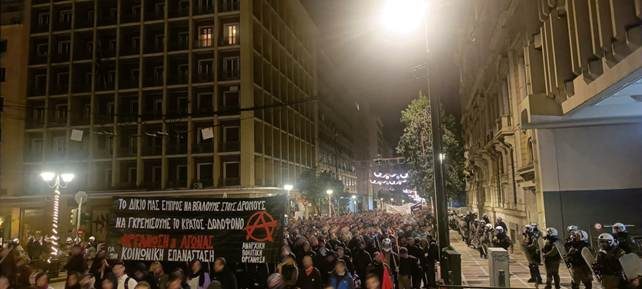
Demonstration during the first day of the International Fair of Thessaloniki, September 2025

Ouzo (FA) : Morning comrades, this interview follows the 13th Congress of IFA which you organised here in Athenes. Can you share with us the story of your organisation that is 10 years old this year ? From which political context it emerged? How are you organised as a federation ?

APO :

The Anarchist Political Organization – Federation of Collectives (APO), was founded as a federalist organization active in Greece since 2015 and a member of the International Federation of Anarchist Associations (IFA). Currently, three anarchist collectives participate in APO, two from Athens, the anarchist collective “Circle of Fire” and the anarchist collective “Omicron72” and one from Thessaloniki, the collective for social anarchism “Black and Red”. The collectives & groups are active also through their own squats and self-organized structures. More specifically, the collective “Circle of Fire” through the squat Lelas Karagianni 37 (founded in 1988) & the collective “Omikron.72” through the anarchist – antiauthoritarian center Antipnoia (founded in 2007), the collective “Black and Red” though the libertarian center No Pasaran (founded in 2023, after the eviction of anarchist squat Mundo Nuevo, which founded in 2015). The autonomous action of the collectives in the cities in which each of them is active and their participation in local actions, processes and projects contribute in the direction of common goals and strategies that emerge within the common project of APO.

APO is organized as a federation with its collectives being its cells, co-operating in a horizontal structure. It is constituted on coherent and adequate political agreements between anarchist collectives that shape their unified movement on a nationwide level through collective procedures in which they coexist equally. Since December 2015, A.P.O. publishes the anarchist newspaper “Γη και Ελευθερία” (in English “Land and Freedom”) and since December 2020 operates the website of libertarian counter-info “Land and Freedom”. Since 2017, we formed a specific thematic group against patriarchy by the women comrades of the groups and collectives of A.P.O. and has a stable and constant presence in the struggles against the state-capitalistic-patriarchic authoritarian system.

A.P.O. is structured on common political beliefs, principles and positions and aims to acquire more and more coherent political agreements in order to be able to formulate long-term strategies of struggle. It seeks to spread the proposals of the anarchist struggle in the movement and society and to form consciences. To contribute in this way, for its part, to the creation of a coherent, radical movement. A movement that will put a stop to any attempt to manipulate, hijack and mediate social and class struggles and to integrate them by reformism. A movement that will clearly promote social revolution as the only realistic way to their final liberation of the people from below from domination and will connect the partial struggles to the overall revolutionary target of overthrowing the state and capital.

The creation of the Anarchist Political Organization – Federation of Collectives ten years ago, is a political and organizational intersection of our functioning and action so far. This choice encapsulates conclusions and experiences from the struggles of yesterday as it is a product of critique and self-criticism while opening new perspectives for the transition from protest and rebellion to the ongoing struggle for social revolution. A.P.O. is the child of the social and class riots of December 2008 (taking under consideration the possibilities and also the limitations that were brought about) and of the great mobilization in 2010-2012. We are inspired by the libertarian movement of CNT-FAI, that through tough struggles, riots and mostly the class, social, political organization managed to make into practice the idea of general subversion of the state and capitalism and the development of social self-management.

Demonstration 15th years since the Revolt of 2008, 6th December 2023, Athens

Ouzo (FA) : Thank you for this. I know that you are involved in many struggles, the students, the squat, palestine, trials support… How do you manage to impose your anarchist agenda within these struggles that are too often co-opted by authoritarians, Marxist, leftists… ?

APO :

For us, A.P.O. is the vehicle of struggle for our constant and consistent intervention in the battles of the social and class war, from the struggles against class exploitation, state repression, fascism and war, against the plunder of nature, against patriarchy and gender violence to the struggles for the defense of public spaces, of the public character of education and health care and the struggles in solidarity with refugees and immigrants and political prisoners. For the more effective diffusion of the anarchist vision of a society of equality, justice, freedom and solidarity, for social and class emancipation, for the organization of the struggle for social revolution and the creation of a bridge between everyday struggle and the vision of anarchy and libertarian communism.

We seek to participate and intervene continuously and actively in the social and class struggles that are antagonistic to the state-capitalist plans, with the aim of radicalizing their content, the processes that frame them and the means of struggle. To interact with social and class projects, in every field of social life, in the workplaces, in schools, universities, neighborhoods, promoting the development of unmediated, anti-hierarchical and anti-institutional struggles.

Within these fields, we are constantly in confrontation with reformism, a perception antagonistic to the revolutionary perspective. Its actors – whether they come from the forces of the parliamentary left, or from the bureaucratic trade union leaderships or from extra-parliamentary bodies and alternative organizations – systematically attempt to mediate social and class struggles and their people, through the assignment of initiatives to “experts”, thus limiting the scope and forms of the struggle, and ultimately leading to denervation, their distortion and slander.

Therefore, it is our constant concern to fight against these reformist logics and perceptions within the struggles and to be constantly awake to prevent attempts to assimilate social and class resistances. Our distinct participation in the open processes of social and class struggle, with full respect for their autonomy, allows us to defend the self-organization and the unconstrained participation of all people in them and the choice of the means of struggle according to their capabilities. Through this vital interaction and the continuous enrichment of our political experiences, we constantly update our political discourse regarding the situation and the prospects of the social and class struggles today. At the same time, we promote the formation of stable structures of resistance in every social and class field, seeking to disseminate our anarchist positions and proposals, not only in the direction of highlighting the limitations of the partial struggles in the present, but promoting their continuous radicalization and connection with the overall prospect of Social Revolution.

Ouzo : How do you feel about IFA after this congress you organised ? Meeting each others was a strong moment of international anarchist cooperation. What are your perspectives as a federation within the IFA ?
APO :

At this point we would like to say that we have not completed our assessment as APO for the Congress of the International of Anarchist Federations that took place in early April 2026 in Athens. This process will be completed in the immediate future, where we have scheduled our organization’s Congress in early June 2026. For our part, however, we can submit a preliminary conclusions of this process, which we believe moved in a positive and productive context towards producing an international position on issues such as the intensification of state and capitalist brutality, the threat of generalization of war, fascism and internationalist solidarity among the oppressed, while offered interesting exchanges of experiences on the intensification of patriarchal violence and the plundering of nature and local peoples worldwide. We hope that this positive direction will continue, with joint agreements on additional issues and with initiatives that will have the horizon of strengthening anarchist positions, discourse and action.

Especially in a period where military operations are expanding abroad and state repression is intensifying at home, we believe that the need for the anarchist movement to be able to form its political value and ideological framework is even more acute, both to influence the consciences of those from below and to defend its positions against the attempts to impose foreign perceptions of the anarchist struggle and the internationalist struggle solidarity. On the one hand, the very dynamics of the changes and overthrows sought by the rulers require the rapid reconstruction of the current at an international level, the urgent need to expand the network of contacts and communication of anarchists at an international level is proven, with the main aim of exchanging experiences, informing about how authoritarian politics is shaped in every geography and the social resistances that are manifested in every part of the planet. In addition, the debate at the international level on the war treaty and the generalized threat of war is crucial.

It is literally a matter of life and death both for the movement and for societies and the oppressed, to be able to form and adopt as coherent as possible a stance amongst anarchists towards militarism, the threat of war and resistance to world domination. We believe that this can be achieved if the comrades in every geography manage to realize that as long as there are visible historical, political, social or even cultural differences between the individual societies (and therefore the movements) that are necessarily formed under the shadow of the nation state, which must be respected, at the same time today’s anarchist analysis ascertains a single state and capitalist condition that dominates and oppresses the entire planet. The deepening of the relevant debate and the corresponding cooperation of anarchists at an international level are basic prerequisites for the strengthening of the anarchist struggle, that is, the strengthening of the very social and class resistances that can protect societies from the threat of war and the intensification of exploitation and oppression.

Ouzo : Efcharisto para poli sidrofoi. Do you have something else to say ? A slogan to share ?

Thank you very much for this interview and we send our solidarity to the comrades all over the world who are fighting in every corner of the earth for a society of Equals, without exploitation and oppression, without masters and slaves, for the new world that we carry in our hearts!

As a closure, we will borrow a phrase from the indigenous Mapuche: MARICHIWEU! (“We will win a thousand times”)

Long live Anarchy!

.

https://i-f-a.org/2026/06/01/interview-with-apo-anarchist-political-organisation-greece-at-the-ifa-congress/

radio student

https://radiostudent.si/druzba/crna-luknja/voices-of-anarchism-2


ڕاپۆرتی ١٣هەمین کۆنگرەی فێدراسیۆنی نێونەتەوەیی ئەنارکیست، ٣-٥ی نیسانی ٢٠٢٦ , ئەسینای پایتەخت، یۆنان

وەرگێڕانی ماشینی

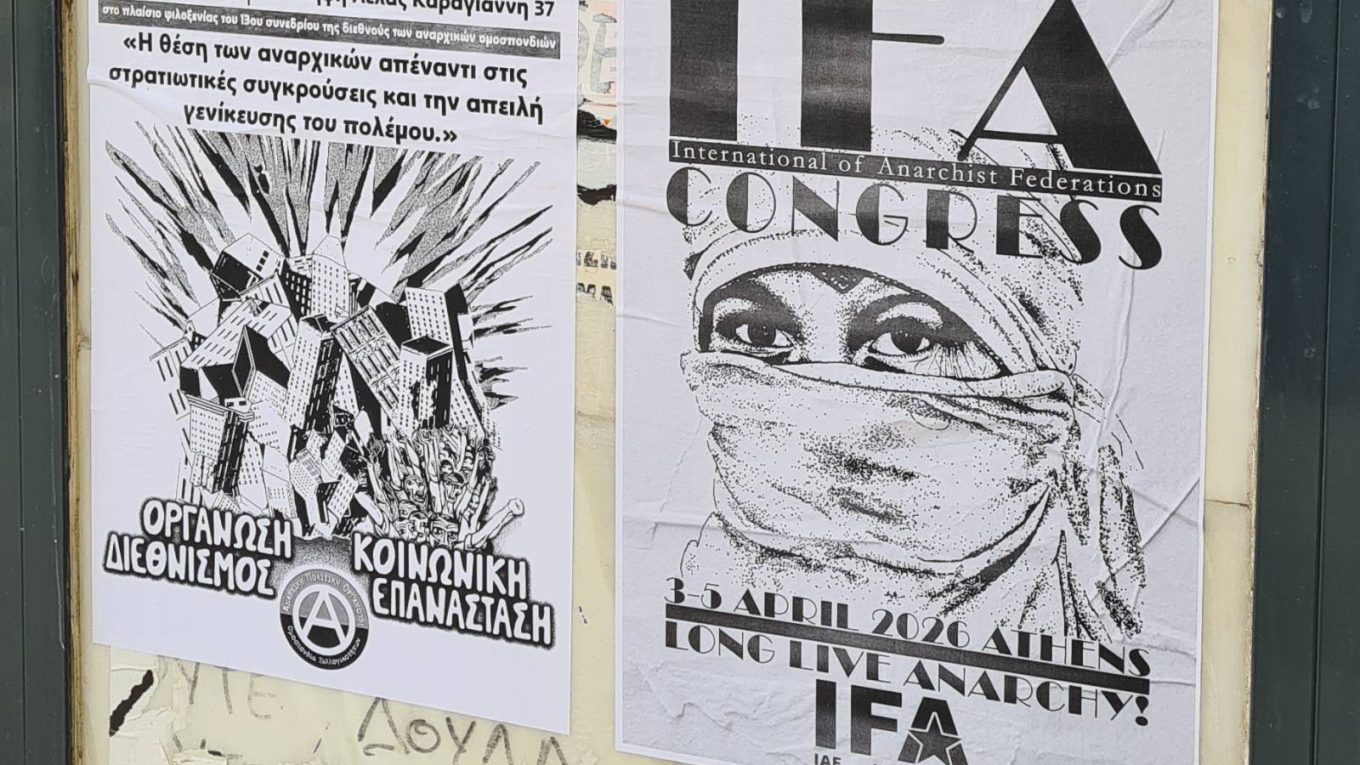
پۆستەری کۆنگرەی ئایفا لەسەر دیوار لە نزیک LK37 ئەسینای ٢٠٢٦

ڕاپۆرتی ١٣هەمین کۆنگرەی ئایفا، ٣-٥ی نیسانی ٢٠٢٦ , ئەسینای پایتەخت، یۆنان

ڕاپۆرتێک لە کۆنگرەی سێزدەهەمی فیدراسیۆنە ئەنارکیستەکانی نێودەوڵەتی (IFA-IAF)، ئەسینای پایتەخت

سێزدەهەمین کۆنگرەی فیدراسیۆنە نێودەوڵەتییەکانی ئەنارکیستەکان (IFA-IAF) لە کۆتایی هەفتەی ٣-٥ی نیسانی ٢٠٢٦ لە ئەسینای پایتەخت بەڕێوەچوو، بە میوانداری Αναρχική Πολιτική Οργάνωση – Ομοσπονδία Συλλογικοτήτων (ڕێکخراوی سیاسی ئەنارکیستی-فیدراسیۆنی بەکۆمەڵەکان -APO). لەنێو ئەو فیدراسیۆنانەی دیکە کە بەشدارییان کردووە بریتی بوون لە فیدراسیۆنی ئەنارکیکا ئیتالیا (FAIt، ئیتاڵیا)، فیدراسیۆنی ئەنارکیست (FA، فەرەنسی زمان)، فیدراسیۆنی ئەنارکیکا سیسیلیا (FAS، سیسیلیا)، فیدراسیۆنی لیبرتاریای ئەرجەنتین (FLA)، فیدراسیۆنی ڕێکخستنی ئەنارکیست، FAO، سلۆڤینیا و کرواتیا)، Федерация на анархо-комунистите в България (FACB، فیدراسیۆنی ئەنارکیست-کۆمۆنیستەکان لە بولگاریا)، فیدراسیۆنی ئەنارکیستەکان (AF، بەریتانیا)، لەگەڵ میوانەکانی تاکەکانی چاودێر لە بەرازیل (Aurora Negra & Terre Livre) و سربیا (Klasna Solidarnost). ئەندامانی فیدراسیۆن و گروپە پەیوەندیدارەکان لە مەکسیک، بەڕازیل، چیک-سلۆڤاکیا، ئەڵمانی زمان و کۆڕبەندی ئەنارکیستی کورد بەشدارییان نەکرد، دووەمیان بەهۆی نیگەرانییەکان لە دۆخی ڕۆژهەڵاتی ناوەڕاست. هاوڕێیانی کوباش بانگهێشت کران بەڵام پەیوەندیکردن لە کاتی گەمارۆی ئابووریدا تادێت قورستر بووە.

بۆ ئەوەی کۆنفرانسەکە بە باشی بەڕێوەبچێت کۆنگرە لە یەک شوێندا میوانداری کرا، کە سکوات لێلاس کاراگیانی 37 (LK37) بوو، کە بلۆکێکی شوقەیی سەرنجڕاکێشە و درێژخایەن، کۆنترین سکواتە لە یۆنان. نانخواردنی نیوەڕۆ و ئێوارە لەلایەن هەڤاڵانی ناو سکواتەکەوە دابینکرابوو و هەندێک شوێنی نیشتەجێبوون بۆ سەردانکەران ئامادەکرابوو. ئامێری وەرگێڕان بەکرێ گیرا بۆ دابینکردنی وەرگێڕانی ڕاستەوخۆ، هەرچەندە زمانی سەرەکی ئینگلیزی بوو. هەروەها LK37 شوێنی کۆبوونەوەی گشتی بوو ‘هەڵوێستی ئەنارکیستەکان سەبارەت بە ململانێ سەربازییەکان و هەڕەشەی گشتاندنی شەڕ’، ئێوارەی شەممە، کە لەلایەن APO میوانداری کرا.

کۆنگرەی IFA هەر سێ بۆ چوار ساڵ جارێک بەڕێوەدەچێت و کۆبوونەوەکانی نوێنەرانی دەستێوەردان (CRIFA) بەکاردەهێنرێن بۆ بەستنەوەی فیدراسیۆنەکان و پلاندانان بۆ کارنامە و چالاکییەکان، بۆ پەرەپێدانی بەڵگەنامەکان بۆ گفتوگۆکردن و دروستکردنی کۆدەنگی. بڕیاردان لە خوارەوە بۆ سەرەوە بە جۆرێکە کە فیدراسیۆنەکان سەرەتا بڕگەیەک بۆ بەرنامەی کار پێشنیار دەکەن و دواتر وەرەقە و هەڵوێستەکانیان لەسەر ئەو بابەتانە بەرهەم دەهێنن بۆ ئەوەی بخرێنە بەردەم کۆنگرە. کۆنگرە بە کۆبوونەوەی پلینۆم داڕێژرابوو کە هەموو فیدراسیۆنەکان ئامادەبوون، بۆ نموونە لەسەر بابەتی دیدگا ئەنارکیستییەکان سەبارەت بە یاخیبوونە جیهانییەکان (وەک ڕاپەڕین لە ئێران، ناوچەکانی دەریای ناوەڕاست، ماداگاسکار، ئەندەنوسیا و نیپاڵ). جگە لەوەش، فیدراسیۆنە بەشداربووەکان لە کۆنگرەکەدا بە هاوبەشی زنجیرەیەک وۆرک شۆپیان لەسەر ئەم بابەتانە ڕێکخست: سودان، ڕاستڕەوی توند، ململانێی پەروەردە، ژینگە، پیاوسالاری و توندوتیژی جێندەری و جیهانی دیجیتاڵی (ماددەی ئۆنلاین و ئاسایشی ئەلیکترۆنی) و هەندێک لایەنی کارگێڕی IFA تاوتوێ کران.

یەکەمین پلینۆمی ‘دژی تۆتالیتاریزمی مۆدێرن لە دەوڵەت، سەرمایەداری و جەنگ’ دیدگاکانی لەبارەی دژە سەربازییەوە هاوبەش کرد. تەوەرەکان بریتی بوون لە دژایەتیکردنی بنکە ئاسمانییەکان یان فڕۆکەکانی ناتۆ (ئیتاڵیا، سیسیلیا، کریت) و فراوانکردنی ناتۆ لە ئەوروپای ڕۆژهەڵات، دووبارە خستنەڕووی خزمەتگوزاریی سەربازی/ڕەشنووس (کرواتیا، فەرەنسا)، سەرکوتکردنی دەوڵەتی چالاکیی هاوپشتی فەلەستین (وەک یاسای تیرۆر کە دژی کردەوەی فەلەستین لە بەریتانیا بەکاردەهێنرێت)، زیادکردنی خەرجییە سەربازییەکان لەوانەش وەبەرهێنانی دوو بەکارهێنان وەک فڕۆکەخانە، بەندەری دەریایی یان سیستەمی شەمەندەفەر فراوانکردنەکان کە کرێکاران دەتوانن دەستوەردانیان تێدا بکەن.

لە کاتێکدا هەمیشە ناتوانرێت بگەینە کۆدەنگی، کۆنگرە پێشکەوتنی بەرچاوی لە کۆمەڵێک پرسدا بەدەستهێنا. بە تایبەتی فیدراسیۆنی ئیتاڵیا و یۆنان هەردووکیان هەڵوێستی وردیان لەسەر ململانێی جێندەری بەرهەمهێنابوو بە بەڵگەنامەکانی پەسەندکراوی فیدراسیۆنەکانیان لەگەڵ تێڕوانینەکان سەبارەت بە توندوتیژی جێندەری سیستماتیکی (APO) و ترانسفێمینیزم (FAIt)، بۆ نموونە لە FAI ئیتالیا: “ڕەگداکوتاندن و فراوانبوونی ترانسفێمینیزم و بزووتنەوە کەیرەکان تادێت پێویستە لە بەرامبەر چڕبوونەوەی ستەمی پیاوسالاریدا لە… قۆناغی ئێستا، کە تێیدا، لە ناوچە جیاوازەکانی جیهان، پەیوەندییەکەی لەگەڵ ستەمی ئایینیدا تادێت بەهێزتر دەبێت، حکومەتی مێلۆنی کردەوەی یاسایی تایبەت بە کارەکتەری پیاوسالاری و خێزانیی بەرهەمهێناوە بۆ پشتگیریکردنی ڕێژەی لەدایکبوون لەناو خێزانی نەریتی و بەرگریکردن لە خێزانی نەریتی و ڕەگەزپەرستی و پلەبەندی، لەگەڵ ئەوەشدا، تەنها میراتی مافی کاردانەوەش نییە نەریتی چەپەکان”. هەروەها FAIt زیادبوونی میلیتاریزەکردنی بەستەوە بە بەرزبوونەوەی کولتوری ماچۆ.

ئاپۆ تیشکی خستە سەر توندوتیژی پیاوسالاری، “لە قۆناغێکدا کە تۆتالیتاریزمی مۆدێرن کۆدەبێتەوە بۆ سەرکوتکردنی ئەو گەلانەی کە ڕاپەڕینن و دەنگی ناسیۆنالیستی و فاشیستەکان لە زیادبووندایە، ژنان، لە هەموو بەشێکی هەسارەکەدا، و بە تایبەتی ئەوانەی چینی پلێبی [چینی کرێکار]، ڕووبەڕووی مەترسییەکانی مردن و ئاوارەبوون، برسێتی و نەخۆشی دەبنەوە، بەدەر لە مەترسییەکانی توندوتیژی ڕەگەزی، ئەشکەنجەی سێکسی و لەسێدارەدان، وەک ئامرازی فەتحکردن و ژێردەستەکردن”. ئاپۆ تیشکی خستە سەر هێرشەکانی سەر مافەکانی لەباربردنی منداڵ لە ئەمریکا، و بەکارهێنانی سیستماتیکی توندوتیژی جێندەری وەک چەکێکی شەڕ لە سودان و فەلەستین، بەڵام هاوشێوەی ئەوەی لە ئیتاڵیادا هەیە، ناسیۆنالیستەکان ڕوو لە ‘سروشتی مێینە’ دەکەن بۆ ئەوەی ڕۆڵێک بۆ دایکایەتی لە بەرژەوەندی نیشتمانیدا دووپات بکەنەوە.

وۆرک شۆپی ‘سەرهەڵدانی ڕاستی دوور، و وەڵامدانەوەی دژە فاشیست’ لەلایەن AF و FA پێشکەشکرا. ئەی ئێف چوارچێوەی سەرهەڵدانی ڕیفۆرم بەریتانیای بەکارهێنا بۆ تاوتوێکردنی لایەنە کولتوورییەکانی ئایدۆلۆژیا و چالاکییە ڕاستڕەوە توندڕەوەکان. گرنگییەکی زۆر بە بەکارهێنانی یاساکانی نەزمی گشتی لە بەریتانیادا هەبوو بۆ سنووردارکردنی ناڕەزایەتییەکان. لە کاتێکدا دەستگیرکردنی پێشوەختە لە ڕێگەی تۆمەتی پیلانگێڕییەوە لە بەریتانیا شتێکی نوێ نییە، بەڵام پێدەچێت ئەمە قورستر بێت بۆ دەوڵەت ڕەوایەتی بدات لەو وڵاتانەی کە مێژووی دیکتاتۆرییەت هەبووە یان تەنانەت وەک بەشێک لە دەستوور باسی دژە فاشیزمیش کراوە. لە ئیتالیا و یۆنان ڕەگ و ڕیشەی دیکتاتۆریەتی فاشیستەکان قووڵە. بەڵام لە ڕووی کولتوورییەوە بابەتگەلێکی فاشیستی وەک ‘خودا، وڵات و خێزان’ دەگەڕێنەوە و ئێستا ئەنارکیستەکان و ناوچەکانیان بە تایبەتی لەلایەن پۆلیسەوە دەکرێنە ئامانج لە سەردەمی سەرکردایەتی ڕاستڕەوی توندڕەوی مێلۆنی لە ئیتاڵیا. هەرچەندە سەردەمی گەشەسەندنی بەرەبەیانی زێڕین لە یۆنان لە ڕابردوودایە، بەڵام بەشێکی بەهۆی سەرکوتکردنیان لەلایەن دەوڵەتەوە دوای کوشتنی گۆرانیبێژێکی دژە فاشیست، بەڵام پەیوەندی ئەندامەکانیان بە ‘ڕووی نەرم’ی ڕاستڕەوی توندڕەوەوە کە زیاتر میدیا دۆستانە، نەماوە. 

لە کاتێکدا کە ڕەنگە لە هەندێک وڵاتدا بتوانرێت سەرنجی مێژوو ڕابکێشرێت، بەڵام لە بەرازیل و بولگاریا و سربیا هەڕەشەی توندوتیژیی نیونازی لەسەر شەقام تا ئەمڕۆش مەترسییەکی گەورەیە چونکە بە ئاشکرا کاردەکەن و ڕووداوەکان کۆدەبنەوە یان ڕووداوەکان دەخەنە ڕوو، هەروەها ڕاستەوخۆ هێرش دەکەنە سەر ئەنارکیستەکان و هەندێکجاریش کوشتنیان لەسەر شەقامەکان هەیە. ئەنارکیستەکان لە بەرامبەردا ڕێگەی داهێنەرانەیان دۆزیوەتەوە بۆ بەرەنگاربوونەوەی ئەوان وەک هاندانی چینەکانی بەرگریکردن لە خۆیان بەکۆمەڵ لە گەڕەکەکاندا، وەک لە کۆمەڵگە فاڤێلاکانی بەرازیل. 

وۆرک شۆپی پەروەردە دەرفەتێکی گرنگ بوو بۆ تێگەیشتن لە گۆڕانکارییەکانی یۆنان کە مۆدێلی هاوبەشی تایبەت بەسەر قوتابخانە ئامادەییەکاندا دەسەپێندرێت و ئەو مامۆستایانەی کە بەرەنگاری بە تایبەتکردن دەبنەوە و زیادبوونی بەکارهێنانی هەڵسەنگاندنی چڕ بۆ قوتابیان لە سەرانسەری مەودای تەمەنەکاندا دەبنە قوربانی. هەروەها مەترسی لەسەر ڕێکخستنی ئەنارکیستی لە زانکۆکاندا زیاد دەکات. بۆیە پێویستی سەندیکای بنەڕەتی بەهێز زۆر گرنگە. لە لایەنی هاندەری شتەکانەوە کۆنگرێس بیستوویەتی دەربارەی قوتابخانەیەکی ئامادەیی بێبەرامبەر Escula Libre de Constitution (ELC) لە بوینس ئایرێس لە ئەرجەنتین کە ئامانجی بەکارهێنانی شێوازە ئەنارکیستەکانی خوێندنە لەگەڵ منداڵانی تەمەن ١٦-١٨ ساڵ و هەروەها تاقیگەی پەروەردەی ئەنارکیست (LEA) لە ساوپاولۆی بەرازیل لە سەنتەری ڕۆشنبیری کۆمەڵایەتی (CCS). دەستپێشخەری LEA کە لەلایەن کتێبخانەی تێرا لیڤرەوە ئەنجامدراوە، ئامانجی لێکۆڵینەوە و بەرهەمهێنان و تاقیکردنەوەی پراکتیکەکانی پێداگۆژییە بۆ منداڵان، لەوانەش بەکارهێنانیان لە پێشانگە کتێبییە ئەنارکیستییەکان بۆ ئاسانکاریکردنی بەشداریکردنی مانادار بۆ منداڵان لەو بۆنانەدا.

دانیشتنی وۆرکشۆپەکە لەسەر ‘تاڵانکردنی سروشت’ لەلایەن ئاپۆوە پێشکەشکرا کە تیشک خرایە سەر کێشە سیاسی و کولتووری و کۆمەڵایەتییەکانی دەوروبەری قەیرانی کەشوهەوا و تاڵانکردنی سروشت و کۆمەڵگا ناوخۆییەکان لەلایەن دەوڵەت و پایتەختەوە. لە دانیشتنەکەدا باس لە دژایەتییە جەماوەرییەکان بۆ دەرهێنانی سەرچاوەکان، سەرمایەداریی ‘سەوز’ و کۆنترۆڵکردنی سروشت و پێکهاتە ناوخۆییەکان لەخۆگرتبوو. هەروەها لە دانیشتنەکەدا باس لە زیادکردنی شارنشینی و بازرگانیکردن و جەنتریفیکاسیۆن کرا. پەیوەندی بەهێز بە دژە سەربازییەوە دروستکرا سەبارەت بە ناڕەزایەتییەکان دژی گەشەپێدانی ژێرخانی. کێشەکانی وەبەرهێنانی گۆڕانی کەشوهەوا لە 

لە کۆتایی کۆتایی هەفتەدا کۆنگرەی ١٣ ی فێدراسیۆنی نێونەتەوەیی ئەنارکیست بەیاننامەیەکی هاوبەشی بەرهەمهێنا ‘دژی دیکتاتۆری جیهانی دەوڵەت و سەرمایەداری، دژی شەڕ و فاشیزم’ کە تیایدا تیشک خرایە سەر دژە سەربازیی، کە پەیوەست بوو بە دانیشتنی پلینۆمەوە. هەروەها بەیاننامەیەکی هاودەنگی بۆ ئەنارکیستەکانی کوبا بەرهەم هێنا. هەردووکیان پێش بڵاوکردنەوەیان لەلایەن فیدراسیۆنەکانی IFA پەسەند دەکرێن. چەپڵەیەکی گەورە بیسترا کاتێک کلاسنا سۆلیدارنۆست (سربیا) نیازی خۆیان ڕاگەیاند بۆ ئەوەی داواکاری پێشکەش بکەن بۆ پەیوەندیکردن بە IFA وەک گروپێکی پەیوەندیدار (ستاتۆیەک کە بۆ ئەو گروپانە بەکاردەهێنرێت کە مەبەستیان گەشەکردنە بۆ فیدراسیۆن). شوێنێک بۆ کۆنگرەی داهاتوو پێشنیار کرا لە کاتێکدا یەکێتی تۆپی پێی ئینگلتەرا ڕەزامەندی دەربڕی لەسەر وەرگرتنی ڕۆڵی سکرتاریەت دوای کارە باشەکانی ڕێکخراوی FAO لە چەند ساڵی ڕابردوودا. پلانێک بۆ ئەنجامدانی کۆبوونەوەیەکی دیکە لە دەریای ناوەڕاست ڕێککەوتن کرا هەروەها ژمارەیەکی داهاتووی گۆڤاری ئایفا سەبارەت بە دیدگا دژە سەربازییەکان، کە فیدراسیۆنە ئەندامانی ئایفا بابەتەکانیان پێشکەش دەکەن. دوابەدوای وۆرک شۆپی زانیاری لەسەر سودان لەلایەن FAS و FA لە کۆنگرێسدا، پۆستەرێکی هاودەنگی نوێ پێشکەشکرا، کە تیشکی خستە سەر خەباتە ئەنارکیستەکانی سودان. دوای کۆتایی هەفتە کۆبوونەوەیەکی هاوپشتی کۆچبەرانی سودان لە ئەسینای پایتەخت بەڕێوەچوو کە دەرفەتێکی بۆ ئەوانەی زیاتر دەمێننەوە بۆ ئەوەی زیاتر دەربارەی دۆخەکە بزانن. هەروەها هاوڕێیانی ئایفا لەلایەن ڕێکخراوی FAO بانگهێشت کران بۆ پێشانگای داهاتووی کتێبی ئەنارکیستی بەڵکان لە شاری سکۆپی لە مەقدۆنیا لە مانگی ئەیلولدا. کۆنگرەکە بە ڕێزلێنانێکی ژاوەژاو بۆ هاوڕێی یەکێتی ئینگلتەرا ژان مارک ڕینۆ – دامەزرێنەری چاپە ئازادیخوازەکان و قوتابخانەی ئەنارکیستی “بۆن ئەڤێنتۆر” – کە لە کۆتایی مانگی ئازاردا کۆچی دوایی کرد، کۆتایی هات.

+++++++++++++++++++++

IFA congress posters on wall near LK37 Athens 2026

Report from the 13th IFA Congress, 3-5 April 2026 , Athens, Greece

A report from the 13th Congress of the International of Anarchist Federations (IFA-IAF), Athens

The 13th Congress of the International of Anarchist Federations (IFA-IAF) took place in Athens on the weekend of 3-5 April 2026, hosted by Αναρχική Πολιτική Οργάνωση – Ομοσπονδία Συλλογικοτήτων (Anarchist Political Organisation-Federation of Collectives -APO). Amongst the other federations which participated were Federazione Anarchica Italiana (FAIt, Italy),  Fédération Anarchiste (FA, French-speaking), Federazione Anarchica Siciliana (FAS, Sicily), Federación Libertaria Argentina (FLA), Federacija za anarhistično organiziranje (Federation for Anarchist Organizing, FAO, Slovenia & Croatia), Федерация на анархо-комунистите в България (FACB, Federation of Anarchist-communists in Bulgaria), Anarchist Federation (AF, Britain), with guests from observing individuals from Brazil (Aurora Negra & Terre Livre) and Serbia (Klasna Solidarnost).  Federation members and associated groups from Mexico, Brazil, Czech-Slovak, German-speaking and Kurdish Anarchist Forum did not participate, the latter due to concerns about the situation in the Middle East. Cuban comrades were also invited but contact has been increasingly difficult during the economic blockade.

To make the conference run smoothly the Congress was hosted at a single venue, the squat Lelas Karagianni 37 (LK37), an impressive long-standing apartment block, the oldest squat in Greece. Lunch and dinner were provided by comrades in the squat and some accommodation was made available to visitors. Translation equipment was hired to provide live translation, although the main language was English. LK37 was also the venue of a public meeting ‘The position of anarchists on military conflicts and the threat of generalisation of war’, on the Saturday evening, hosted by APO.

The IFA Congress takes place every three to four years with intervening delegate meetings (CRIFA) being used to connect the federations and plan agendas and activities, to develop documents for discussion and consensus building. The decision-making is bottom up such that federations initially propose items for the agenda and then produce their papers and positions on those topics to be presented to the congress. The congress was structured with plenary sessions with all federations present, for example, on the subject of anarchist perspectives on worldwide insurrections (such as the uprising in Iran, areas of the Mediterranean, Madagascar, Indonesia and Nepal). In addition, participating federations to the congress co-organised a series of workshops on the following topics: Sudan, the far right, education struggles, environment, patriarchy & gender violence and the digital world (online materials and cybersecurity) and some administrative aspects of IFA were discussed.

The first plenary ‘Against modern totalitarianism of State, Capitalism and War’ shared perspectives on anti-militarism. Themes included opposition to NATO air bases or planes (Italy, Sicily, Crete) and NATO expansion in Eastern Europe, reintroduction of military service/draft (Croatia, France), state suppression of Palestine solidarity activity (such as the terrorism law used against Palestine Action in UK), increased military spending including dual-use investments such as airport, sea port or rail system expansions that workers could intervene in.

Whilst it is not always possible to reach consensus, the congress made significant progress on a number of issues. In particular the Italian and Greek federations had both produced detailed positions on gender struggles with documents approved by their federations with insights on systemic gender violence (APO) and transfeminism (FAIt), for example from FAI Italy: “The rooting and expansion of transfeminism and queer movements is increasingly indispensable in the face of the intensification of patriarchal oppression in the current phase, in which, in various parts of the world, its link with religious oppression is increasingly strong. In Italy, the Meloni government has produced specific legislative acts of a patriarchal and familist character to support the birth rate within the traditional family. Familism and the defence of the traditional, sexist and hierarchical family, however, are not only the heritage of the reactionary right, because there is also a familism in the tradition of the left.” The FAIt also linked increased militarisation to a rise in macho culture.

APO focussed on patriarchal violence, “In a period in which modern totalitarianism is mobilized to suppress the peoples who revolt and nationalist and fascist voices are increasing, women, in every part of the planet, and especially those of the plebeian [working class] strata, are faced, beyond the risk of death, displacement, hunger and disease, with the daily threat of gender-based violence, sexual torture and executions, as tools of conquest and subjugation.” APO highlighted attacks on abortion rights in USA, and the systematic use of gender violence as a weapon of war in Sudan and Palestine, but also similarly to that in Italy, nationalists’ turn to ‘female nature’ to assert a role for motherhood in the national interest.

The ‘Rise of the Far Right, and Anti-fascist Response’ workshop was presented by the AF and FA. AF used the context of the rise of Reform UK to discuss cultural aspects of far right ideologies and activity. There was great interest in the use of public order laws in Britain to limit protest. Whilst pre-emptive arrest via conspiracy charge is not new in the UK, this appears harder for the state to justify in countries where there has been a history of dictatorship or where anti-fascism is even mentioned as part of the constitution. In Italy and Greece the roots from fascist dictatorships run deep. But culturally fascist themes such as ‘God, Country and Family’ are coming back, and now anarchists and their locales are being specifically targeted by the police during the far-right leadership of Meloni in Italy. Although the heyday of Golden Dawn in Greece is in the past, in part due to their suppression by the state after their murder of an anti-fascist singer, their members’ links to the more media friendly ‘soft face’ far right have not disappeared.

Whilst it may be possible to appeal to history in some countries, in Brazil, Bulgaria and Serbia the threat of neo-nazi violence on the street is still today a big threat because they operate and meet or put on events openly, as well as directly attacking and sometimes murdering anarchists on the streets. Anarchists have in turn found creative ways to combat them such as encouraging mass self-defence classes in neighbourhoods, such as in Brazil favela communities.

The education workshop was an important opportunity to understand the changes in Greece where private partnership models are being imposed on high schools and teachers who are resisting privatization and the increased use of intensive evaluation of pupils across the age range are being victimised. There is also increased threat to anarchist organising in universities.  Therefore the need for strong base unions is vitally important. On the encouraging side of things Congress heard about a free high school Escula Libre de Constitucion (ELC) in Buenos Aires, Argentina that is aimed at using anarchist methods of schooling with 16-18 year olds and also the Anarchist Education Laboratory (LEA) in São Paulo, Brazil at the Social Culture Center (CCS).  The LEA initiative, carried out by the Terra Livre Library, aims to study, produce, and experiment with pedagogical practices for children, including their use at anarchist bookfairs to facilitate meaningful input of children at those events.

The workshop session on ‘Plundering of Nature’ was introduced by APO focussed on political, cultural and social problems surrounding the climate crisis and the plundering of nature and local communities by the state and capital. The session included discussion of popular oppositions to resource extraction, ‘green’ capitalism and control over nature and local communities. The session also discussed increased urbanisation, commercialisation and gentrification. Strong links were made to anti-militarism regarding protests against infrastructural development. Problems with the $1T UN ‘2030 Agenda’ climate change investment were highlighted.

At the end of the weekend the 13th IFA congress produced a joint statement ‘Against Global Dictatorship of State and Capitalism, against War and Fascism’ focussed on anti-militarism, linked to the plenary session. It also produced a solidarity statement for the Cuban anarchists. Both will be ratified by the IFA federations before publication. Great applause was heard as Klasna Solidarnost (Serbia) announced their intention to apply to join IFA as an associated group (a status that is used for groups who have the intention of growing into a federation).  A venue for the next congress was proposed whilst the FA agreed to take on the Secretariat role after the good work of FAO over the last few years. A plan to hold another meeting in the Mediterranean was agreed as was a forthcoming issue of the IFA journal on anti-militarist perspectives, where IFA member federations will present articles. Following the informative workshop on Sudan by FAS and FA at the Congress, a new solidarity poster was presented, highlighting Sudanese anarchist struggles. After the weekend a Sudanese migrant solidarity meeting was held in Athens which gave an opportunity for those staying longer to learn more about the situation. IFA comrades were also invited by FAO to the next Balkan Anarchist Bookfair in Skopie, Macedonia in September. The congress concluded with a noisy tribute to FA comrade Jean-Marc Raynaud – founder of Libertarian Editions and the anarchist school “Bonne Aventure” – who died at the end of March.

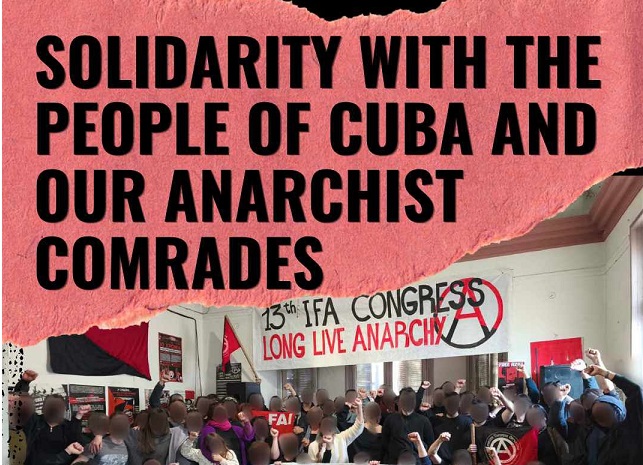
هاوپشتی لەتەک خەڵکی کوبا و هاوڕێ ئەنارکیستەکانمان

وەرگێرانی ماشینی

پۆستەری هاودەنگی ئەنارکیستەکانی کوبا ئەسینای ٢٠٢٦ بڕدرا

هاوپشتی لەتەک خەڵکی کوبا و هاوڕێ ئەنارکیستەکانمان

وەرگێڕانەکانی خوارەوە بە زمانی ئیسپانی، یۆنانی، ئیتاڵی، سلۆڤینی , سربۆ-کرواتی، زیاتر بۆ شوێنکەوتن .

بەیاننامەی هاوبەشی نێودەوڵەتی فیدراسیۆنە ئەنارکیستەکان (IFA-IAF)

لە ١٣هەمین کۆنگرەی نێودەوڵەتی فیدراسیۆنە ئەنارکیستییەکانەوە کە لە ئەسینای پایتەخت (٣-٥ی نیسانی ٢٠٢٦) بەڕێوەچوو، پشتیوانی و هاودەنگیی بێوچانمان بۆ هاوڕێ ئەنارکیستەکانمان لە کوبا دەنێرین، کە نەیانتوانی گەشت بکەن بۆ بەشداریکردن لە کۆبوونەوەکانی IFA.

گەمارۆی ئابووری لەسەر کوبا لە شەستەکانی سەدەی ڕابردووەوە بوونی هەیە، بەڵام لە چەند مانگی ڕابردوودا ئەمریکا هەڵوێستی خۆی ڕەقتر کردووەتەوە و سزای بەسەر ئەو کەشتیانەی نەوت دەگوازنەوە بۆ دوورگەکە سەپاندووە و هەڕەشەی گومرگی لەسەر ئەو وڵاتانە کردووە کە نەوتی دابین دەکەن.

ناچارکردنی سزای تەواوی گەلێک بۆ ژیان لە ژێر بارودۆخێکی توند و وێرانکەردا (بەبێ هیچ کارەبایەک، کە پێویستە بۆ کارکردنی ژێرخانی بنەڕەتی بۆ مانەوەی مرۆڤ) تاوانێک دژی مرۆڤایەتی پێکدەهێنێت.

نە لێبوردەیی، نە بێدەنگی بەرامبەر بەو تاوانەی کە ئەمریکا دژی خەڵکی کوبا ئەنجامی دەدات، و دژی ئەو شەڕە جیهانییەی کە یەکەمیان دژی مرۆڤایەتی ئەنجامی دەدات – شەڕێک کە سبەی دەگاتە هەموومان، لە هەموو گۆشەیەکی زەویدا.

نێودەوڵەتی فیدراسیۆنە ئەنارکیستییەکان (IFA-IAF)

٣-٥ی نیسانی ٢٠٢٦ – ئەسینای پایتەخت، یۆنان


++++++++++++++++++++++++

Solidarity with the people of Cuba and our anarchist comrades

Translations below in Spanish, Greek, Italian, Slovenian, Serbo-Croatian, more to follow.

Joint statement of the international of anarchist federations (IFA-IAF)

From the 13th Congress of the International of Anarchist Federations, held in Athens (April 3–5 2026), we send our unwavering support and solidarity to our anarchist comrades in Cuba, who were unable to travel to participate in the IFA proceedings.

The economic embargo against Cuba has been in place since the 1960s, but in recent months U.S.A. has hardened its stance, imposing sanctions on ships carrying oil to the island and threatening tariffs against countries that supply it.

The punitive coercion of an entire people to live under extreme, devastating conditions (without any electricity, essential for the functioning of basic infrastructure for human survival) constitutes a crime against humanity.

No tolerance, no silence against the crime being committed by the United States against the people of Cuba, and against the global war the former is waging against humanity — a war that tomorrow will reach all of us, in every corner of the earth.

International of Anarchist Federations (IFA-IAF)

April 3–5 2026 – Athens, Greece

[Spanish]

Solidariedade com o povo de Cuba e nossos camaradas anarquistas

14 de Abril de 2026

Desde o 13º Congresso da Internacional das Federações Anarquistas, realizado em Atenas (3 a 5 de abril de 2026), enviamos nosso apoio e solidariedade inabaláveis aos nossos camaradas anarquistas em Cuba, que não puderam viajar para participar dos trabalhos da IFA.

O embargo econômico contra Cuba está em vigor desde a década de 1960, mas nos últimos meses os EUA endureceram sua postura, impondo sanções a navios que transportam petróleo para a ilha e ameaçando aplicar tarifas contra os países que o fornecem.

A coerção punitiva de todo um povo a viver em condições extremas e devastadoras (sem eletricidade, essencial para o funcionamento da infraestrutura básica para a sobrevivência humana) constitui um crime contra a humanidade.

Nenhuma tolerância, nenhum silêncio diante do crime que os Estados Unidos estão cometendo contra o povo de Cuba e contra a guerra global que estão travando contra a humanidade — uma guerra que amanhã atingirá a todos nós, em todos os cantos da Terra.

Internacional das Federações Anarquistas (IFA-IAF)
3 a 5 de abril de 2026 – Atenas, Grécia

[greek]

Αλληλεγγύη στο λαό της Κούβας και τους αναρχικούς συντρόφους/ισσες μας

Από το 13ο Συνέδριο της Διεθνούς των Αναρχικών Ομοσπονδιών που διεξήχθη στην Αθήνα (3-5 Απριλίου 2026) στέλνουμε την αμέριστη υποστήριξη και αλληλεγγύη μας στους αναρχικούς συντρόφους/ισσες από την Κούβα καθώς δεν ήταν δυνατόν να ταξιδέψουν για να συμμετάσχουν στις διαδικασίες της IFA.

Το οικονομικό εμπάργκο κατά της Κούβας ισχύει από τη δεκαετία του 1960, αλλά τους τελευταίους μήνες το αμερικανικό κράτος έχει σκληρύνει τη στάση του, επιβάλλοντας κυρώσεις σε πλοία που μεταφέρουν πετρέλαιο σε αυτή και απειλώντας με δασμούς τις χώρες που την προμηθεύουν.

Ο τιμωρητικός εξαναγκασμός ενός ολόκληρου λαού να ζει κάτω από ακραίες εξοντωτικές συνθήκες χωρίς καθόλου ηλεκτρικό ρεύμα, απαραίτητο για τη λειτουργία των στοιχειωδών υποδομών ανθρώπινης επιβίωσης, συνιστά έγκλημα κατά της ανθρωπότητας.

Καμία ανοχή και σιωπή μπροστά στο έγκλημα που διαπράττεται από τις ΗΠΑ πάνω στον λαό της Κούβας και στον παγκόσμιο πόλεμο που διεξάγουν τα κράτη ενάντια στην ανθρωπότητα κι αύριο θα φθάσει σε όλους μας, σε κάθε γωνιά της γης.

Διεθνής των Αναρχικών Ομοσπονδιών (IFA-IAF)

3-5 Απρίλη 2026, Αθήνα – Ελλάδα

[Italian]

SOLIDARIETÀ CON IL POPOLO CUBANO E I NOSTRI COMPAGNI ANARCHICI

Pubblicato il 2026/04/13 da blogfas

Dal 13° Congresso dell’Internazionale delle Federazioni Anarchiche, tenutosi ad Atene (3-5 aprile 2026),
inviamo il nostro incondizionato sostegno e la nostra solidarietà ai nostri compagni anarchici a Cuba, che non hanno potuto
recarsi sul posto per partecipare ai lavori dell’IFA.

L’embargo economico contro Cuba è in vigore dagli anni ’60, ma negli ultimi mesi gli Stati Uniti hanno
irrigidito la loro posizione, imponendo sanzioni alle navi che trasportano petrolio verso l’isola e minacciando dazi contro i
paesi che lo forniscono.
La coercizione punitiva imposta a un intero popolo affinché viva in condizioni estreme e devastanti (senza alcuna
elettricità, essenziale per il funzionamento delle infrastrutture di base per la sopravvivenza umana) costituisce un crimine
contro l’umanità.

Nessuna tolleranza, nessun silenzio di fronte al crimine che gli Stati Uniti stanno commettendo contro il popolo
cubano e alla guerra globale che stanno conducendo contro l’umanità — una guerra che domani
raggiungerà tutti noi, in ogni angolo della terra.

Internazionale delle Federazioni Anarchiche (IFA-IAF)
3-5 aprile 2026 – Atene, Grecia

[Slovenian, with introduction]

Solidarnostna izjava Internacionale anarhističnih federacij (IFA-IFA)

Spodaj objavljamo kratko solidarnostno izjavo z ljudstvom na Kubi, ki jo je na svojem 13. kongresu sprejela Internacionala anarhističnih federacij (IFA-IFA). Kongres, ki se ga je udeležila tudi delegacija iz Slovenije, se je odvil med 3. in 5. aprilom v Atenah.

Internacionala že dolga leta ohranja stike in podpira anarhistično gibanje na Kubi. Načrtovana je bila tudi udeležba kubanske delegacije na nedavnem kongresu, ki pa je bila zaradi zaostrenih razmer in težkih okoliščin odpovedana. Kongres je kljub temu obravnaval situacijo na Kubi in se zavezal k nadaljnji podpori tam živečim ljudem in anarhističnemu gibanju.

Po St. Imieru (2012), Frankfurtu (2016), Ljubljani (2019) in Massenzaticu (2023) je bil to že peti kongres Internacionale z delegacijo iz Slovenije. Od leta 2012 je namreč članica Internacionale tudi Federacija za anarhistično organiziranje (FAO), ki deluje v Sloveniji in hrvaškem delu Istre od leta 2009.

Zbiranje pomoči in druge solidarnostne aktivnosti za Kubo pri nas organizira pobuda Prebijmo embargo.

Obsežno poročilo iz kongres in ostale javne izjave, ki so bile tam sprejete, bomo na tej spletni strani objavili v kratkem. ★

SOLIDARNOST Z LJUDSTVOM NA KUBI IN NAŠIMI TOVARIŠI

13. kongres Internacionale anarhističnih federacij, ki je med 3. in 5. aprilom potekal v Atenah, pošilja našo neomajno podporo in solidarnost našim anarhističnim tovarišem na Kubi, ki se zaradi razmer niso mogli udeležiti kongresa IFA.

Gospodarska blokada proti Kubi velja že od 60. let prejšnjega stoletja, vendar so ZDA v zadnjih mesecih močno zaostrile položaj, uvedle sankcije proti ladjam, ki prevažajo nafto na otok, in zagrozile s carinami proti državam, ki jo dobavljajo.

Kaznovalno prisiljevanje celotnega naroda, da živi v skrajnih, uničujočih razmerah (brez električne energije, ki je nujna za delovanje osnovne infrastrukture za preživetje ljudi), predstavlja zločin proti človeštvu.

Nobene strpnosti, nobenega molka proti zločinom, ki ga ZDA izvajajo proti kubanskemu narodu! Proti globalni vojni, ki jo ZDA vodijo proti človeštvu – vojni, ki bo jutri dosegla vse nas, v vsakem kotičku sveta.

Internacionala anarhističnih federacij (IFA-IAF)

3. – 5. april 2026 – Atene, Grčija

[serbo-croatian]

Solidarnost sa narodom Kube i našim saborcima anarhistima

Sa 13. kongresa Internacionale anarhističkih federacija, održanog u Atini, od 3. do 5. aprila 2026, šaljemo nepokolebljivu podršku i solidarnost našim saborkinjama i saborcima anarhistima na Kubi, koji nisu bili u mogućnosti da putuju i učestvuju u IFA protokolima.

Ekonomski embargo protiv Kube na snazi je još od 1960ih, ali su poslednjih meseci SAD zauzele još čvršći stav, izričući sankcije i prema brodovima koji dovoze naftu do ostrva, kao i preteći sankcijama zemljama koje je budu snabdevale.

Ovakva kaznena prinuda protiv celog jednog naroda kako bi on živeo pod ekstremnim i užasnim uslovima – bez struje, koja je neophodna za funkcionisanje osnovne infrastrukture i ljudski opstanak – predstavlja akt genocida i zločin protiv čovečnosti

The 2026 Anarchist Bookfairs List

The 2026 Anarchist Bookfairs List

Features, Apr 12th
Now into its ninth year, the increasingly venerable Freedom bookfairs list offers a healthy showing of old and new events – and for the first time, every Saturday in May is filled!

~ Freedom News ~

In fact, there are events happening up and down the country from late April through to June if you have a hankering to find out more about anarchism, dabble in some workshops or even just meet lovely people while out and about of a Spring weekend …

For the sake of easy calendar entries, here’s the list by date:

April 25th: Hull Radical Bookfair
April 26th: Bristol Radical History Festival
May 2nd: Somerset Anarchist Bookfair
May 9th: Edinburgh Anarchist Bookfair
May 23rd: Teesside Radical Bookfair
May 30th: Newcastle Ewan Brown Anarchist Bookfair
September 26th: London Anarchist Bookfair
October 17th: Peterborough Radical Bookfair
October 24th: Bristol Anarchist Bookfair
October 31st: Manchester and Salford Anarchist Bookfair
November 14th: Dorset Radical Bookfair
November 22nd: Belfast Radical Bookfair

Note: All details subject to change, last updated 12 April – email editor [at] freedompress.org.uk with any additions or corrections
Belfast

Belfast Radical Bookfair November 22nd, at Vault 39, Corporation St 11-am-3pm Facebook | radical.bookfair.belfast [at] gmail.com

This year’s is set to be the collective’s biggest yet, with a number of new events throughout the day. Spaces are limited, to register your stall please email.
Bristol

Bristol Radical History Festival April 26th-27th at the M-Shed & Cube Microplex 10am-4.30pm Website | Facebook | brh [at] brh.org.uk

The Bristol Radical History Festival returns this Spring for its eighth edition, with history talks, panel discussions, films, history walks, performance and exhibitions. There will also be space devoted to stalls, where you can stock up on history pamphlets, books and more, from over 30 publishers and distributors. The main part of the festival is held over two days at two main venues: Saturday 25th April at Bristol’s social history museum on the city’s historic harbourside, M Shed; and, Sunday 26th April at the volunteer-run arts centre and cinema the Cube Microplex. This year’s event has four main themes: Propaganda, Utopias, Welsh Risings and the 1926 General Strike. Full programme of events.

Bristol Anarchist Bookfair October 24th Time TBC at the Trinity Centre Website | Facebook | bristolbookfair [at] riseup.net More details to follow
Dorset

Dorset Radical Bookfair November 14th Website | Facebook

More to follow …

Edinburgh

Edinburgh Anarchist Bookfair May 9th at the Quaker Meeting House 11am-6pm Instagram | Facebook | edinburghanarchistbookfair [at] protonmail.com

You can’t keep Edinburgh’s radicals down – in recent years there’s been the anarcha-feminist bookfair, the radical bookfair, and now in its latest incarnation featuring radical books, art, activist groups, workshops, food & drinks, and great company, with stalls from AK Press, PM Press, Black Lodge Press, Lighthouse Books and many more.
Hull

4rd Hull Radical Bookfair April 25th at The New Clarence Pub 11am-4pm Facebook

Around a dozen or so stalls in a more central locale, as well as a Know Your Rights workshop for protests, and a celebration of the centenary of the 1926 General Strike.
London

Anarchist Bookfair in London September 26th at Rich Mix Details TBA Website | Facebook | Bluesky | Mastodon | anarchistbookfairlondon [at] riseup.net

The big annual jamboree is heading back to East London after its exciting underground excursion last year.
Manchester

Manchester and Salford Anarchist Bookfair October 31st 10am-4pm at the People’s History Museum Website | Facebook | Instagram | manchester [at] bookfair.org.uk

A spookily Halloween-timed event, keep an eye on their website for info
Middlesborough

Teesside Radical Bookfair May 23rd 12pm-5pm at The Auxiliary Website | Facebook | teessideradicalbookfair [at] inventati.org

Get in touch if you’d like a stall at a very reasonable £10 per 6ft table.
Newcastle

Newcastle Ewan Brown Anarchist Bookfair May 30th 10am-5pm at the Star and Shadow Cinema Website | Facebook | Contact: newcastleanarchistbookfair [at] protonmail.com

2026 marks the 5th annual Newcastle Ewan Brown Anarchist Bookfair, a dynamic celebration of the life and legacy of Ewan Brown, and a tribute to the radical history, present, and future of the North-East. Activists, artists, thinkers, and community members will gather in the spirit of resistance and solidarity. The event will feature an exciting mix of dozens of stalls, workshops, live music, and art, all hosted in the incredible Star and Shadow Cinema, nestled in the heart of Newcastle’s east end..
Peterborough

Peterborough Radical Bookfair October 17th 11am-5pm at the George Alcock Centre, Stanground, Peterborough Facebook

Let’s talk about ‘communities of resistance’. Cos let’s face it we need ’em! What does a community of resistance mean to you? How do you find your tribe? What does being part of a community feel like to you?.
Somerset

Somerset Anarchist Bookfair May 2nd All day at Rockaway Park Instagram | getinvolved [at] rockawaypark.co.uk

A day of talks, performance, workshops and conversation. Alongside live performances from Riot Act and Boff Whalley workshops will dig into the Spycops Inquiry, radical design and feminist sociology. There’s an exhibition in the gallery, a free film in the evening, a not-for-profit community library and plenty of stalls, all free entry and £5 parking.
Not announced yet …

Cambridge Radical Bookfair: We’re told there are plans afoot for later in the year, but a date hasn’t been nailed down yet. Instagram | cambridgeanarchist [at] gmail.com
Sheffield Anarchist Bookfair: Happened in October last year but unclear if it’s on again. sharc0114 [at] proton.me for enquiries
Gŵyl y Gwrthsafiad Radical Community Festival (Swansea): No word yet, but another one usually later in the year. Website | Instagram

Related
Your guide to 2017 anarchist bookfairs in the British Isles
9 January 2017

In “Arts and Culture”
Anarchist Bookfairs in 2018
6 March 2018

In “Events”
The 2025 Anarchist Bookfairs List
19 August 2025

In “Events”
AnarchismBookfairs

Find thousands of titles, including our latest book Fight For a New Normal – Anarchism and mutual aid in the Covid-19 pandemic crisis
Recent Articles
Mónica Caballero: “Never let vulnerable comrades be or feel alone”

The Chilean anarchist prisoner talks about her situation, views on patriarchy and speciesism, and anti-prison politics ~ La Zarzamora ~ La Zarazamo…
Prague activists confront anti-abortion march

Two thousands feminists and anti-fascists resisted ultra-conservative “March for Life” on Saturday ~ Petr Zewlakk Vrabec, *Alarm ~ Over…
Notes from the US: A long, dark tunnel

With Americans so poorly informed, it’s hardly surprising that their acceptance of atrocities is correspondingly high ~ Louis Further ~ The &…
Artemis II: The space spectacle that distracts us from earthly misery

It’s easier to talk about the “lunar feat” than about the consequences of the military and economic machinery operating down here…
Anarchademics descend on Oxford

The Anarchist Studies Network organised three sessions at the Political Studies Association Conference 2026 ~ ASN Co-convenors ~ The Anarchist Stud…
Other Stuff
the freeDoM ANArChIst NeWsPAPer ArChIVes

Having gone mostly online in 2014, Freedom continues to publish an irregular paper today. Those and many other issues stretching back to our founding in 1886 are online above, at libcom.org, and via the Sparrow’s Nest.
freeDoM As A PuBLIshING house

The book publishing arm of Freedom Press has a history stretching back to the 19th century and continues to publish today. Check out our catalogue to order stock or you can order from Central Books.
Get our NeWsLetter

Keep up with the news, features and interviews Freedom produces over the year with our irregular newsletters.
CoNtACts

Email
editor {at} freedompress.org.uk
Phone
07 5651 60446
Address
84b Whitechapel High St, London E1 7QX (12-6pm)
Map
Housekeeping

Design & hosting
Squashed Fly

Copyright
Freedom uses the Attribution- NonCommercial-ShareAlike 4.0 International license. All other content providers reproduced retain copyright unless stated otherwise.

We are socialists, disbelievers in property, advocates of the equal claims of all to work for the community as seems good — calling no-one master, and of the equal claim to each to satisfy as seems good to them, their natural needs from the stock of social wealth they have laboured to produce …We are anarchists, disbelievers in the government of the many by the few in any shape and under any pretext.

Freedom, a Journal of Anarchist Socialism, Vol 1, No. 1, October 1886


The 2026 Anarchist Bookfairs List

(fr) Anarchist Federation – Jean-Marc, the struggle continues

(fr) Anarchist Federation – Jean-Marc, the struggle continues

Date: Tue, 7 Apr 2026 20:35:45 +0100

Jean-Marc Raynaud wasn’t always a troublemaker. He started out as a troublemaker in his youth. From high school onward, he and his friends from the Café de la Paix formed a discussion group focused on secularism; a theme that would stay with him throughout his life. His rationalist commitment as a freethinker was undeniable. With this group of friends, he also became involved in the anti-nuclear movement, opposing the Braud-et-Saint-Louis power plant and a harmful highway construction project. Few people know this, but when he enrolled in law school in Bordeaux, his intention was to become… a police commissioner! Fortunately, a wind of emancipation was blowing through the spring of 1968, and Jean-Marc became friends with Sanchez and Jean Barrué. The 1970s would be the decade in which his libertarian commitments were solidified. It was during this period that he joined the Anarchist Federation, held regular meetings in Rochefort, and campaigned for male contraception in general and vasectomy in particular. At the same time, he joined the cremationists’ union and their newspaper, “La Flamme” (The Flame), promoting the practice of cremation. He wasn’t ahead of his time; his time was behind him.

Once the ball was rolling, he would theorize and put into practice a life of continuous struggle, dedicated to creating concrete alternatives to the world he refused to accept. Uncle Bakunin’s summer camps, the self-managed daycare center, the Bonaventure libertarian school, and other such activities filled the time of this committed educator who, not content with simply taking action, also wrote numerous texts—more than 600 cataloged to date—for various activist newspapers and magazines.

“I always wanted to be a publisher,” Jean-Marc confided to his longtime friend, Jean-Claude Richard. On the advice of the latter, and after managing the publishing house Le Monde Libertaire, he founded Éditions Libertaires, which published over 250 books and awarded the prestigious Ni Dieu Ni Maître prize for many years. This publishing house still exists and is a benchmark in French-language anarchist publishing. Many authors join us in expressing their sadness.

Despite the great failure of his life—namely, achieving unity within the libertarian movement—Jean-Marc did not give up and tirelessly continued to defend a non-negotiable humanism. Thus, when the despicable Manuel Valls put the stripping of citizenship on the agenda during Hollande’s presidency, he publicly asked to have it revoked himself. The local press still remembers it.

Jean-Marc had his card. His citizen of the world card, which he never failed to show to the police. always quick to suppress the freedom of peoples.

Today, a great man leaves us, but his struggles and convictions will neither be forgotten nor abandoned.

We are all fierce Raynauds! Chaucre

Anarchist Federation

, Saint-George-d’Oléron

Wednesday, April 8, 2026

https://federation-anarchiste.org/?g=Lien_Permanent&b=1_27

The state is not a class instrument, but an instrument of a single class, the rich  and  the powerful people.

17/03/2026

Those who expect fundamental changes in the state may not understand the essence and nature of the state. The state is never in the interest of the workers and the poor, but is an instrument in the hands of their oppressors. That is why the very rich and the powerful people  support the the elections to vote for their candidate .

In US  there are 900 billionaires , 11 of whom have a combined net worth of $ 1.35 trillion and invited to the second inauguration of President Trump.

The billionaires donated more than $450m to elect Trump last year, Trump named a dozen billionaires to top positions. They include education secretary Linda McMahon ($3bn in wealth), commerce secretary Howard Lutnick ($3.2bn), and Steve Witkoff ($2bn) as chief Iran/Ukraine/Gaza negotiator. Trump also asked Musk (more than $800bn) to run the wrecking-ball crew at the so-called “Department of Government Efficiency”.

Showing how the system serves billionaires, the ultra-rich elite won lots of goodies in Trump’s Big Beautiful Bill. Of its $2tn in tax cuts, $750bn will reportedly go to the richest 1% of Americans, according to Brookings.

It’s not your imagination that inequality is growing worse – billionaires are pulling further away from everyone else, with the number of billionaires jumping by more than 50% since 2017. The richest 1%, whose wealth has more than doubled since 2017, owns 32% of the nation’s wealth, more than 10 times the 2.5% share owned by the bottom 50%. The richest 0.1% own 14.4% of the nation’s wealth, up 6 percentage points since 1990.

Together those six donated nearly $1bn. According to OpenSecrets, Musk topped the list with more than $280m, while Timothy Mellon, an 83-year-old banking heir, was second at $197m. Miriam Adelson, widow of a casino magnate, was third at $147m. Michael Bloomberg was the top donor to Democrats at $64m.

billionaires’ political spending skyrocketed, jumping 160-fold since 2010 and 2.5 times since 2020. Billionaires gave $16m in the 2008 presidential election and $231m in the 2012 election, the first after Citizens United, before soaring to $2.6bn in 2024.

According to the Harris Poll’s annual Americans and Billionaires Survey, conducted last November, 53% of Americans believe billionaires threaten our democracy. What’s more, 71% of Americans, including 64% of Republicans, say there should be a wealth tax on top earners, and 53% (up from 46% in 2024) say there should be limits on wealth accumulation.

Iran. Let’s desert the war!

Iran. Let’s desert the war!

The US and Israeli attack on Iran has triggered an escalation of war that is setting on fire the area between the Mediterranean and the Persian Gulf.
A global explosion appears ever closer.

The risk for those who oppose the Iranian theocratic regime from an internationalist, class-based, and anti-patriarchal perspective is that the regime, weakened after the January uprising, will strengthen in the face of attacks.

The United States and Israel care nothing about the aspirations for freedom that cost no fewer than twenty thousand deaths and ten thousand political prisoners to those who chose to challenge the Islamic Republic.

Trump is not aiming for regime change that would meet the demands of the insurgents, because he is satisfied with securing favorable agreements in the energy sector.

At stake for the United States is control of resources and the Strait of Hormuz, the isolation of Russia, and an end to hydrocarbon trade with China.

Israel is attempting to settle scores with Hezbollah by exploiting divisions among Lebanese Shiites.
It is a risky operation, especially if the Israeli government is not content with controlling the Strip up to the Litani River, attempting a more in-depth ground operation, which could be very demanding militarily and a harbinger of new protests and defeatist initiatives internally.
Netanyahu is walking a razor’s edge, with a calculated move to secure a stronger position in the elections. The Likud government and its far-right religious allies are banking on expansion in the West Bank and war to avoid a voter rejection, which would spell the end of the prime minister and the current governing alliance. However, the strategy of unity in the face of a historic enemy risks becoming worn out, especially if the conflict is not short: thousands are fleeing from the north of the country, hit by a hail of missiles.
Thirty percent of Israel’s population, the poorest, has no safe haven against the bombs.

The Trump administration’s trade wars have failed to deliver the desired results, eroding part of the consensus it had gained by promising a return to the golden age, with the United States once again the linchpin of the global economy.
Polls indicate a sharp loss of support that could prove disastrous in the midterm elections.

The Trump administration, after the coup in Venezuela, is once again playing the military card, because it is the only area in which it maintains undeniable superiority over its strongest competitors.
This gamble is not without risks, as demonstrated by the tragic outcomes of the wars unleashed by the United States in Iraq and Afghanistan. These are countries where US military power enabled a victory on the ground that turned into a defeat, because the ferocity of the military occupation and the absence of solid allies, which only massive non-repayable investments could have guaranteed, led to retreats that demonstrate the US’s inability to implement its colonial projects.

Iran is not Venezuela. This is demonstrated by attacks that are far more forceful and incisive than the pantomimes carried out during the 12-day war last June.

Not only that.
Fifteen days into this this new bloody phase of the conflict, the United States and Israel, despite having inflicted severe blows on the Iranian military, massacring over a thousand civilians, appear unable to control the situation. The attempt to use Iranian Kurdish militias has so far been rebuffed by the newly formed coalition of parties from Iran’s Kurdish-speaking region.

The systemic chaos Trump is likely targeting could undermine US alliances in the region, which are already less solid than in the past.
Just consider a country like Turkey, a historic ally that has long been acting independently, actively supporting Palestinian factions linked to Hamas in Palestine, allying with Al Jolani in Syria, and settling accounts with the Kurdish opposition. Today, Turkey is bidding to become the region’s linchpin, a neo-Ottoman force, in direct competition with Israel.

In Iran, the internationalist, class-based, and anarchist political and social opposition opposes the war. Trump and Netanyahu’s war is not being fought in their name. The death of the tyrant does not bring the end of the dictatorship, because only the struggle of those who, from below, attempt to break the clerical and patriarchal order can open real horizons of freedom, sparking a revolutionary process.

Israeli and US bombs slaughter the civilian population while an increasingly bloodthirsty and ferocious regime deprives political prisoners of food and uses them as human shields on military bases.

Iranian anarchists oppose the war and the regime.
Israeli deserters and conscientious objectors supported the uprising in Iran and oppose the war.
We support them.

In our country, squares were animated by some sections of exiles chanting Israel and the United States’ attack on Iran.
In other squares, promoted by the diverse Italian left, flags of the Islamic Republic and images of Khamenei were waved.
Disturbing signs.

It’s a dark moment.
Italy, for years a logistics hub for the war in Ukraine and Gaza, now plays a key role in supporting the war in Iran.
The Sigonella bases and the MUOS in Niscemi play a central role in war intelligence operations.
The missile frigate Martinengo has been deployed to Cyprus, and military aid has been sent to the Gulf countries.
The government denies wanting to go to war, but our country has already been at war for years.
Italian military missions have been active for decades in Iraq, Kuwait, Lebanon, Cyprus, Palestine, Egypt, as well as in the Red Sea and the Horn of Africa.

We desert.
We do not enlist on the side of this or that state.
We stand with those who desert war in every corner of the earth.

We want a world without borders, armies, oppression, or exploitation.

Only an international humankind can lay the foundations for that world of free and equal people that can put an end to war.

The fight to close Italian, US, and NATO military bases is more crucial than ever.

Deserting war is not just a slogan, but a concrete practice, strengthened by the transnational alliance of the oppressed and the exploited.
Let’s sabotage war!

The Correspondence Commission of the Italian Anarchist Federation – FAI

War is never the answer. International solidarity. Desertion

War is never the answer. International solidarity. Desertion

The recent attack on Iran carried out by the United States and Israel on February 28 is neither an isolated act nor a historical accident. It is yet another well-planned manifestation of an imperial logic that disguises aggression as defense, supremacy as security, war as a moral necessity, and capitalist imperialism as democracy. We know that every power, when it strikes, invokes the need for prevention; every bomb is carefully cloaked in technical, surgical, and inevitable language—and even words of peace. But we already know who will pay the price for such violence; the victims are always the same: children, workers, the poor, young people sent to their deaths, families losing their homes and futures, and oppressed peoples. And we also know that the chaos following this aggression will fuel new wars and further fanaticism.

Regimes can only be opposed and overthrown by their own people, and it is certain that even the popular movements that have opposed the Iranian regime in recent years will be swept away by American imperialist arrogance. Let it be clear: there are no humanitarian wars, nor are there any liberating bombings. Wars are political choices, not natural phenomena. There is a global structure of domination that feeds on fear, nationalism, and voluntary submission. Governments speak of existential threats, but the only permanent threat to the people is precisely the continuous and historical intertwining created by states between military power, economic interests, mafias, and media propaganda.

True security stems from social justice, cooperation among peoples, and an end to the economic exploitation that fuels conflict. True prevention lies in dismantling the state structures that generate war: military bases, the military-industrial complex, alliances based on the threat of constant conflict, and all repressive state laws that target any form of dissent.

Wars must be met with desertion. To desert today means, above all, to desert propaganda. It means rejecting ethnic and religious hatred. It means rejecting the rhetoric of inevitable war, rejecting the fear of true freedom. It means supporting conscientious objection, protecting those who oppose imperialism, and building grassroots international solidarity networks. It means opposing the militarization of our societies and our territories—from Birgi to MUOS and Sigonella—and defending spaces of autonomy, mutual aid, and direct organization.

We unequivocally condemn all forms of imperialism, regardless of the flag or state behind them. We denounce the hypocrisy of those who speak of international law while trampling on it. And we remember that no people are our enemies.

If there is a flame to be lit, it is that of solidarity among the oppressed.

If there is a rebellion to be waged, it is against blind obedience.

If there is a revolution to be prepared, it is one that makes war impossible because it makes domination over our lives impossible.

May consciences awaken. Let fear turn to rage. Let those in power know they can no longer count on our passivity and our fear of being free.

Against every state. Against every regime.

Against imperialist war: Desertion, International Solidarity.

Only a society of free and equal people will sweep away all imperialism.

Sicilian Anarchist Federation

March 2, 2026